AI agents are executing production workflows in 2026, but governance and business strategies are still catching up as Shadow AI seeps past network controls and enterprises strive to absorb AI transformations into their operational structures. Learn from the five structural flaws we are observing today and the engineering response to each deficiency in today’s tech stack governance.
Many businesses are still using outdated software compliance frameworks when it comes to managing AI systems that are inherently probabilistic and nondeterministic. This approach leads to several issues: an expanded attack surface, unauthorized access points, data leaks, and serious vulnerabilities in workflows that involve automation. If your company is still treating AI governance like just another compliance checklist, you are likely on a path toward operational decline or design flaws that will drain your resources faster than you might think.
People often assume governance is all about saying “no.” But here’s the key point: if your governance framework is mostly rejecting ideas, it is not performing at the expected level. Effective governance should be about saying “yes” confidently and frequently while keeping the enterprise safe from major risks. The goal is to ensure organizations can deploy AI systems with trust, understand the emerging risks, and incorporate system controls to mitigate malfunctions and threats.
AI Governance Is To Operationalize Trust In AI Technologies At Enterprise Scale

|
Compliance |
AI Governance |
|
Are we following regulations? |
Can we operate AI safely and effectively? |
|
Periodic reviews |
Continuous oversight |
|
Documentation |
Operational controls |
|
Human processes |
Automated enforcement |
|
Legal ownership |
Cross-functional ownership |
|
Risk avoidance |
Risk management and value creation |
Five Major Structure Flaws That Cause Enterprise AI Governance to Fall Short
The Shadow AI Blind Spot
While security teams harden sanctioned AI deployments, business units quietly integrate unsanctioned third-party models and local wrappers. CI of AI-powered features into SaaS with your current subscriptions, which often skips the IT review process, or employees using unauthorized AI tools to generate budget reports. Or, due to strict or outdated policies, developers are left to find workarounds, which could accelerate the adoption of Shadow AI in existing rusty procedures. This Shadow AI bypasses corporate egress controls, creating data exfiltration risks and violating core CIA Triad (Confidentiality, Integrity, Availability) business principles. Evaluation and discovery must shift from periodic audits to continuous network telemetry and API gateway inspection.
Getting It Wrong: Blocking Without Visibility
Prohibition without network-layer enforcement drives usage underground. Employees route personal AI sessions over mobile connections. IT loses all telemetry, every audit trail, and the ability to revoke OAuth tokens on exit.
The Fix: Three-Tier Tool Registry with DLP Enforcement
Classify all AI tools as approved, restricted, or prohibited. Enforce the network layer via Netskope or Nightfall AI with real-time DLP. Revoke OAuth token scopes centrally. Provide sanctioned enterprise alternatives before issuing any restrictions.
Treating AI as a Deterministic Software Project
In the traditional Software Development Life Cycle (SDLC), we usually expect consistent, predictable results from our testing. When it comes to large language models (LLMs) and agents, things get tricky as their outputs are probabilistic and adaptive. Using regular unit tests and static code analysis does not quite cut it; these methods overlook issues such as hallucinations, degraded context, and the surprising behaviors agents can exhibit when executing a task. This calls for a new approach: an Agent Development Life Cycle that includes ongoing checks to ensure everything stays aligned with our goals.
The DevSecOps framework encompasses seven micro-steps: strategizing key design elements with project objectives, planning, coding, testing, debugging, deploying, and monitoring. The ADLC has governance measures in the engineering stack rather than treating it as a post-deployment audit. This continuous lifecycle ensures that agent health remains secure, strictly constrained by the system’s design, and aligned with designated business tasks. When companies put the ADLC into action, they can actively manage agentic risks. This approach allows them to expand their AI initiative safely and create real business value right from the design stage all the way through ongoing production management.
“Most of the companies that are struggling… are kind of treating it like it’s still traditional software.”
— Dael Williamson, EMEA CTO, Databricks
Static, Bloated Policy Documents
The days of the “50-page PDF AI Policy” are long gone. Today, accustomed static documents can not keep up with the rapid upgrades in AI and practices, from weekly model updates to new tool functionalities, route in operation processes, regulations, and real-time consumer contributions. So, what should businesses do instead? Leverage automated, AI-driven workflows to record and manage documentation; these can also enable evaluators to catch non-compliant templates and unsafe tool configurations before they ever merge into the codebase.
There are two smart alternatives an enterprise should consider. First is: Governance by Design. This approach focuses on building an AI software infrastructure that is inherently secure and compliant. It integrates into the development workflow and can automatically spot issues like non-compliant prompt templates, unsafe tool setups, and any deviations from policy before they become a problem. Then there is an option to switch to a ‘Living Playbook’. This would involve having dynamic, machine-readable rules embedded directly into Continuous Integration/Continuous Deployment (CI/CD) pipelines. Tools like Open Policy Agent (OPA/Rego) or AWS Cedar can establish a unified standard for ‘Policy as Code’ to life, making sure that compliance is a seamless part of the process rather than an afterthought.
“If your security function isn’t using AI, it’s like taking a knife to a gun fight.”
— Mike Salem, CISO, IHS Towers
Under-Indexing on Internal Risks and IP Exposure
Businesses underestimate internal factors that can cause major breaches or the loss of valuable intellectual property. This can stem from prompt injection, unauthorized fine-tuning of datasets, and the leakage of sensitive information due to agentic open-loop actions. A reason being the security frameworks in place are intended solutions for user applications and are applied to AI agents that can reason, retrieve, and act autonomously.
Prompt injection attacks can take advantage of these channels to alter how agents behave or even gain access to connected systems to pull out confidential data. On top of that, when organizations grant too many permissions and have lax identity controls, it opens the door to unauthorized access, privilege escalation, and potential decision-making encroachment. Agents that operate across separate systems can inadvertently leak personally identifiable information (PII) or trade secrets into lower-security logs or through external web searches. To tackle these challenges effectively, organizations need to implement stronger network-layer protections. This means using real-time Data Loss Prevention (DLP) tools like Lakera Guard or Nightfall AI to monitor prompt content, employing cryptographic hashing and tracking for all Retrieval-Augmented Generation (RAG) ingestion pipelines to identify compromised documents, and establishing immutable WORM-locked archives for model configurations, system prompts, and definitions of agent tools as part of their Infrastructure as Code strategy.
Ignoring the Non-Human Identity (NHI) Explosion
Enterprise identity management has mostly focused on people. Employees get an account; their permissions are provided to them based on their role, and when they leave the organization, their access is removed. The introduction of Agentic AI has radically altered this approach by increasing the scope and counteraction technology for new working agents. AI agents, retrieval pipelines, and orchestration frameworks require their own machine identities to access data, invoke tools, make queries of enterprise systems, and accomplish their objectives without human intervention.
One issue with AI governance today is that companies are attempting to secure access for AI agents using policies that were designed for employees. Since AI technology is executed at blazing-fast speed, developers tend to hardcode these machine identities and give them permissions that are way too broad to keep things running smoothly. This often leads to the agents being left out in the cold, without anyone keeping an eye on them. There is no human manager to take away access from an AI agent that is sitting inactive and vulnerable. According to Grip Security, the largest attack vector is due to the use of OAuth tokens. Any time an autonomous agent holds a static, human-like permission, it guarantees that the agent can escalate through entry points and increase the risk of involuntary lateral movement.
“The expression ‘non-human identity risk’ is becoming a rising concern… This immense network of digital credentials has become the largest—and most vulnerable—attack surface in enterprise security.”
— Eric Fourrier, CEO, GitGuardian
Governance by Design: The Engineering-First Fix
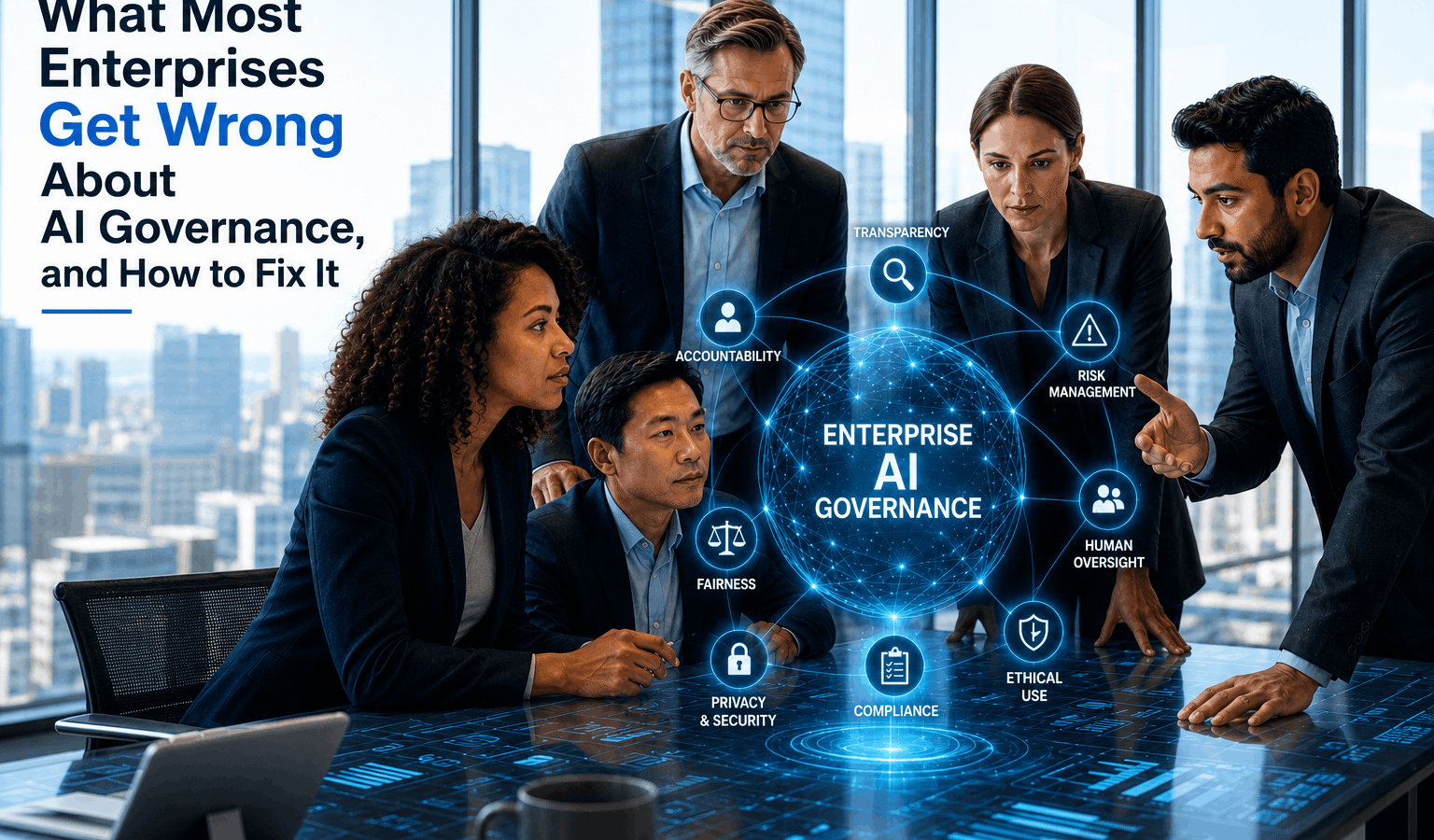
Governance has evolved way beyond just being a policy exercise; it’s now more like an engineering discipline. These days, you really need a cross-functional AI council that pulls in folks from security, legal, data engineering, and business units. This council creates a structure for accountability and helps make sure the technical guardrails are in line with what the business is willing to take on in terms of risk.
According to the Forrester Responsible AI Solutions Landscape, there are three essential pillars that can’t be ignored when it comes to governance: explainability, accountability, and trustworthiness. The key thing here is that these pillars should be woven into the runtime layer instead of being something you just look at after deployment. Each of these pillars connects directly to specific technical controls, making it more crucial to get them right from the start.

System Controls
-
Design Principles First – Security requirements, access boundaries, and interoperability constraints are defined at the architecture stage. Policy-as-Code via OPA/Rego or Cedar is enforced at CI/CD gates and API gateways before merging, not as a post-deployment review.
-
Permissions, Boundaries, Sandboxes – Every agent operates inside an explicitly scoped permission boundary. New MCP tools are executed in sandboxed WASM environments before production workflow access. The least privilege is the architectural default, not a policy aspiration.
-
Agent Roles and Privilege Definition – Agents receive fixed roles with enumerated privileges. Escalation paths are explicitly blocked in the codebase. Role definitions version-controlled alongside the agent code and subject to code review gates for any change.
-
Interoperability Standards – Managing the probabilistic nature of underlying LLMs with deterministic wrappers: Agent-to-agent and agent-to-system communication uses typed, versioned schemas enforced via MCP. Leveraging industry-standard protocol prevents downgrade attacks. MTLS, signed message, and guardrail models to validate agent reasoning before execution manifests as protected orchestration layers at the communication level.
Security Frameworks
-
Non-Human Identities – Treating NHI with first-class identity and access management constructs. Agent credentials are provisioned, rotated, and revoked through dedicated NHI registries, separate from human IAM. Credential sprawl and execution validations are audited continuously, not at point-in-time reviews.
-
Just-In-Time Access – Ephemeral, task-scoped credentials granted at initiation that expires/revoked at completion. No persistent, elevated access. Combine JIT with ABAC policies evaluating contextual signals: prompt sensitivity, user role, and data classification tier before granting execution rights.
-
Role-Based Access Controls – RBAC governs both human-facing AI tool access and agent-to-resource access. Complement with Attribute-Based Access Controls for dynamic, context-aware enforcement at runtime. Access matrices are reviewed on the same cadence as model inventory audits.
-
Audit Trails and Gateway Checkpoints – Every agent action logged: task context, credential used, resource accessed, output hash. Gateway checkpoints intercept and halt out-of-bound actions. OPA/Rego enforces rules at runtime; violations trigger automated rollback and alert routing.
-
Real-Time Threat Detection – SIEM pipelines extended with AI-specific use cases: behavioral anomaly detection on latent space representations, AI API traffic classification, and prompt injection pattern monitoring. Sleeper agent activations and reward hacking detected via anomaly scoring on embedding outputs.
-
Vulnerability Testing and Threat Hunting – Continuous Automated Red Teaming (CART) using Garak or Promptfoo for adversarial fuzzing, jailbreak pattern detection, and multi-hop injection simulation against every prompt iteration in CI/CD. Proactive threat hunting for corrupt instances across agent registries and MCP supply chains.
Governance Graphs, Lineage DAGs & Compliance Automation
-
The Governance Graph as a Directed Acyclic Graph (DAG) – Leverage foundational exposure assessment platforms like IBM’s Governance Graph to map the complex topology of your AI environment. This involves constructing a DAG that links raw data sources, vector stores, model weights, prompt versions, and downstream application endpoints.
-
Blast Radius Analysis – By querying the Governance Graph, SecOps can instantly calculate the “blast radius” of a compromised model or poisoned dataset, identifying exactly which enterprise applications and user cohorts are exposed.
-
GitOps for AI & Immutable Archiving – Treat model configurations, system prompts, and agent tool definitions as Infrastructure as Code (IaC). Store them in version control with WORM (Write Once, Read Many) compliance locking. This enables rapid forensic reconstruction and automated rollback in the event of an alignment failure.
-
Automated Compliance Mapping – Translate regulatory requirements (EU AI Act, NIST AI RMF) into executable Rego policies. Automate evidence collection directly from your CI/CD metadata and observability pipelines, replacing manual audit prep with continuous compliance reporting.
|
Platform / Tool |
Category |
Engineering Function |
Industry Recognition / Positioning |
|
Enterprise AI Governance Platform |
Enterprise AI inventory, lifecycle governance, automated risk assessments, control workflows, and regulatory cross-mapping (EU AI Act, NIST AI RMF, ISO/IEC 42001). |
Recognized in Gartner AI Governance and AI TRiSM research; leading enterprise governance platform. |
|
|
AI Use-Case Governance |
AI use-case intake, approval workflows, risk scoring, control evidence collection, and governance at the business use-case layer, enabling a single foundation model to support multiple governed deployments. |
Emerging AI governance platform recognized in enterprise AI governance discussions. |
|
|
Agent Trust Management |
Real-time detection and cryptographic verification of third-party consumer AI agents, intent analysis, agentic commerce fraud prevention, and granular edge policy control (e.g., allowing browsing but blocking unauthorized checkout/scraping). |
Enterprise security platform focused on securing AI agents and autonomous workflows. |
|
|
AI Data Governance |
AI-driven data classification, records governance, regulatory compliance, lifecycle management, defensible disposal, and data readiness for AI workloads. |
Featured in Responsible AI and information governance market research; strong records governance platform. |
|
|
Policy-as-Code |
Automated policy enforcement across Kubernetes, CI/CD pipelines, API gateways, admission controllers, and runtime checkpoints; translates governance policies into executable controls. |
Open-source engineering standard for cloud-native policy enforcement. |
|
|
AI Security Testing (CART) |
LLM vulnerability assessment, adversarial fuzzing, jailbreak detection, prompt injection testing, model evaluation, and automated red-teaming integrated into CI/CD pipelines. |
Widely adopted within AI security and DevSecOps toolchains. |
|
|
Runtime AI Observability |
End-to-end agent tracing, prompt and response evaluation, tool-call success metrics, latency, token consumption, semantic drift detection, production monitoring, and continuous evaluation. |
Leading observability stack for production AI and LLM applications. |
|
|
AI-Native Data Protection and System Security |
Real-time prompt inspection, sensitive data detection, DLP at AI gateways, prompt injection protection, credential leakage prevention, and Shadow AI policy enforcement. |
Specialized AI security platforms focused on GenAI runtime protection and data governance. |
Governance Debt Compounds Like A Technical Debt
The Cisco 2026 study revealed something quite striking: about 90% of privacy programs have expanded their focus due to the rise of AI. However, governance maturity does not appear to have caught up with this expanded business need. Many organizations rolling out agentic AI workflows still depend on old-school methods, such as periodic risk assessments and retrospective log analysis. These strategies might work well in stable environments, but they are inadequate for keeping up with the demands of agentic architectures that perform open-loop actions in real time.
Companies must adopt Governance-as-Code design strategies, secure the Agent DevSecOps lifecycle, adopt minimum-trust NHI architectures, and utilize protocol-level standards such as MCP. These strategies can help businesses transition from a reactive stance on risk to a more proactive and scalable approach to ensuring confidence in AI systems. The organizations that succeed in the AI era will not necessarily be those that build the most powerful models, but those that build the most secure, observable, auditable, and resilient AI systems.