Over the years, artificial intelligence has been referred to as chatbots. Natural language models, including ChatGPT, Claude, and Qwen, have changed the way information is sought, programmes are constructed, content is produced, and communication is accomplished. The ability to interpret and create human-like language has made artificial intelligence widely accessible; however, all these systems still lack a fundamental quality: they rely more on the analysis of textual information than on the physical understanding of the world.
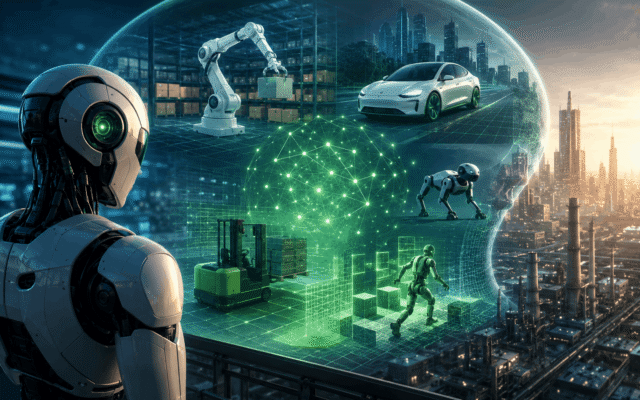
The next step in the evolution of AI is taking the technology beyond human conversations and towards creating world models – systems that would allow AI to know how the world works and, therefore, predict future events and process the information before making decisions. Unlike mere text generation, world-building aims at developing an understanding of surroundings first, which, eventually, allows AI to interact with the outside world in a more meaningful way.
Researchers at leading AI firms are convinced that this technological leap is likely to be as groundbreaking as the introduction of artificial intelligence. If chatbots unite technology and communication, the creation of world models is expected to enable AI to finally understand reality.
World Models – What Are They?
World Models is an AI technology that forms a mental map of its surroundings. The system perceives not just language, but also visual and sensory information, and human interactions, and forms a concept of how objects and events change with time to predict the future instead of reacting to the present.
While humans use mental models without conscious effort, many studies show that drivers approaching an intersection can imagine all possible scenarios based on experience. For example, a child can predict the future position of a ball before catching it. A world model tries to create an AI that can similarly use its imagination before deciding on the action.
This type of predictive reasoning differs from traditional AI systems, which perform well in recognising patterns but cannot understand cause-and-effect situations.
The need for more than just chatbots in AI technology
The advancement of large language models has been propelled by their training on large amounts of text data. They can perform functions like summarising written content, answering questions, generating computer code, and assisting in creative tasks. However, sheer linguistics do not enable an AI to learn about how the effect of gravity relates to an object that falls or about how a pedestrian is likely to behave when crossing the road.
For instance, in the case of a chatbot, it may successfully indicate the principles and key points necessary for riding a bicycle. It may explain the components of balancing, steering, and pedalling. However, even though it can explain these concepts extremely well, it doesn’t mean that it has practical knowledge that will allow it to complete these tasks.
In the case of AI moving into robotics, self-driving cars, healthcare, manufacturing, and science, practices show that intelligent systems must have additional knowledge besides linguistic knowledge.
How Do World Models Learn About Reality?

World models, as opposed to language models, rely on their ability to learn predictions regarding the development of their environment over time. That is to say, while language models base learning on the sequential arrangement of the elements of a sentence, world models acquire knowledge by analysing incoming successive flows of visual information and physical interactions.
Consider, for example, a robot operating in a warehouse which sees several boxes moving every day. After getting constant experience of seeing boxes moved in different manners, one day it suddenly understands not only the location of the boxes and their movements in the past but also everything about how they would move if someone pushed, lifted, or dropped a box.
To be more precise, researchers call this process equipping an AI with ‘imagination.’ Rather than conducting experiments with every possible alternative in real life, the AI is able to act within its own internal simulation. Thus, the number of mistakes is reduced, and the efficiency is improved.
The importance of world models in potentially revolutionising AI
One of the most significant advantages of world models is their capability to make decisions based on anticipation rather than reaction. Current AI techniques are mostly reactive; the AI knows how to respond after an event has taken place. World models enable AI systems to sense a change before it occurs.
In the field of robotics, this ability can work wonders. Currently, industrial robots carry out repetitive jobs in controlled surroundings. If there are unforeseen barriers, misplaced items, or movement of people in front of the robots, human operators intervene. With the introduction of world-modelling technology, robots could predict and prepare for such situations instead of freezing when challenged with the unexpected.
Another field that is likely to benefit from world models is autonomous driving technology. A self-driving vehicle constantly makes numerous evaluations about the presence of pedestrians, bikes, traffic lights, and other vehicles. Instead of detecting the objects only, world models would allow the AI to anticipate the behaviour of other objects.
World models are also seen to play a significant role in improving AI agents supporting complicated planning activities. Instead of merely fetching the information, future AI assistants might create different scenarios prior to providing their recommendations. In the case of travel assistance by AI, for instance, the AI system might analyse weather conditions, traffic congestion, airport delays, and hotel availability to provide the best itinerary.
Actual Illustrations of World Models Progress
Top AI firms are making significant investments in world model development, signalling a transition from talk to action in this technology.
One of the many companies working in this area is Wayve, a UK-based company working on an AI technology that learns how to drive through experience. Rather than following fixed algorithms provided by engineers, the company has made a process whereby its AI systems have to predict the behaviour of traffic and roads. This way, Wayve’s technologies can operate their vehicles in a more human-like manner thanks to having their world models operating.
Another major accomplishment comes from NVIDIA with its Cosmos technology. Instead of generating text, Cosmos creates realistic environments where automation is employed. In this case, the technology is used in the field of warehouse robots, which is where Cosmos revolutionises the prospects of development. Namely, it enables a warehouse robot to learn how to use its forks, how to move in crowds, etc.
Adding to this advancement, Google DeepMind is in on the action with Genie, their AI tool that produces interactive worlds based on video footage and images. Unlike standard visuals, Genie contributes to the creation of worlds filled with AI agents that can move around and learn through interaction with multiple objects. It is believed now that such worlds will be essential for training future robots and intelligent agents.
Similarly, Tesla has applied the same principles when it comes to autonomous driving by creating its Full Self-Driving technology, which relies on continuous streams of video rather than single images. With this method, its system can see how traffic accidents are likely to occur. Despite the fact that the technology has not yet been recognised as a full-world model, it is acknowledged by AI experts as an important step towards that goal.
What Leading AI Experts Suggest
Yann LeCun, at the forefront of AI world models, has been an ardent supporter of the concept all along. He invariably points out that language models cannot produce human-like intelligence by themselves, as they do not have real intelligence regarding the way the world operates. He believes that, for future AI to be able to function in the world, it must learn the concepts of causality, spatial awareness and long-term planning.
Fei-Fei Li, a visionary in computer vision technology, also reflects on the fact that intelligence goes beyond language only. She has consistently maintained that AI needs to combine visual perception and reasoning in order to comprehend the world around it properly. Her works have significantly influenced computer vision development and created the ground for embodied AI and world models research.
Research scientist David Ha, the author of one of the earliest

world model entries, proved that AI can successfully learn in simulated environments built on its internal predictions. Data shows that intelligent systems do not necessarily have to rely on costly real-life experiences if they can train in the world imagined independently.
According to Google DeepMind CEO Demis Hassabis, prediction and simulation are very important for future artificial intelligence systems. Hassabis thinks that an artificial intelligence system capable of predicting future developments can greatly improve a variety of fields such as science, robotics, and medicine.
How World Models Can Change Life as We Know It
World models are often talked about as tools for robotics, but they have the potential to go much beyond that.
In medicine, doctors could use artificial intelligence systems that can predict different outcomes related to diseases. Instead of relying on just historical data, physicians will be able to compare the effects of various treatments through predictive models so that they can choose the most suitable treatment for a given patient.
Companies involved in manufacturing are also researching digital twins, which can be understood as being virtual duplicates of factories imitating real production. Using world models will increase the intelligence of these digital twins, as the system will be able to forecast breakdowns of the equipment and improve production planning and maintenance.
Climate science is another promising field of application of the technology. A predictive artificial intelligence system that can model weather, floods, hurricanes, and fires can help governments in their preparation and usage of emergency resources.
Even the gaming industry can benefit from the application of world models. Future video games can be built on a completely different approach to the creation of AI characters that will not behave in a certain manner but can also anticipate player strategies and can create adventurous gaming experiences.
Difficulties That Should Still Be Addressed
Beyond their impressive capabilities, world models are one of the hardest fields of AI to work on. To accurately depict reality requires an enormous amount of visual, sensory, and interaction data, which makes these models far more costly to train than traditional language models.
Another issue is the precision of predictions. The real world is far more difficult and unpredictable than one could expect, and even little mistakes in the simulation can become very serious over time. The errors in the way the machine perceives the world can lead to negative outcomes in the real world, which is very critical in such spheres as healthcare or autonomous driving.
This means that it is extremely important to make sure that the machine operates in a safe manner and to research and develop new evaluation methods, more realistic simulations, and even novel surprise-validation methods for the AI to be able to function properly in real-life situations.
The Future Belongs to AI That Understands the World. The Future of AI is Bright.
World models will complement the chatbots rather than just replace them. The most advanced AI systems of the future are likely to have the ability to speak and communicate, as well as have reasoning, memory, and planning abilities. These systems would do more than just answer questions—they would understand the context and foretell the outcomes, and decide based on their simulated experience of the real world.
The dawn of the AI age started with computers learning to predict words. However, what comes next is computers learning how to predict reality. As companies such as Meta, NVIDIA, Google DeepMind, Tesla, and AI startups keep researching world models, the technologies are getting closer to AI that can not only talk like people but also act in the way the human mind functions.
The next step in artificial intelligence may not be making an improved chatbot. However, it may be creating the AI that could imagine and foresee what will happen in reality and thus take necessary actions.