
Ten magazines, ten blogs and ten subreddits that cut through the AI hype cycle.
The way people follow AI has changed. A year ago, most readers relied on established tech magazines for AI updates. Now we're seeing a clear migration: developers are spending more time in specialized blogs and Reddit threads than in monthly features, while enterprise audiences are splitting attention between governance-focused publications and frontier research labs.
This shift reflects how quickly AI moves. Monthly magazines still matter for context and analysis, but the signal many readers want—new model releases, benchmark comparisons, open-source launches—appears first in company blogs and community forums. The sources gaining traction are the ones that publish within hours of a development, not days.
Below are thirty platforms where momentum is building or holding steady, grouped by the kind of signal each delivers. Some are rising because they cover what others miss. Others matter because they set the agenda everyone else follows.
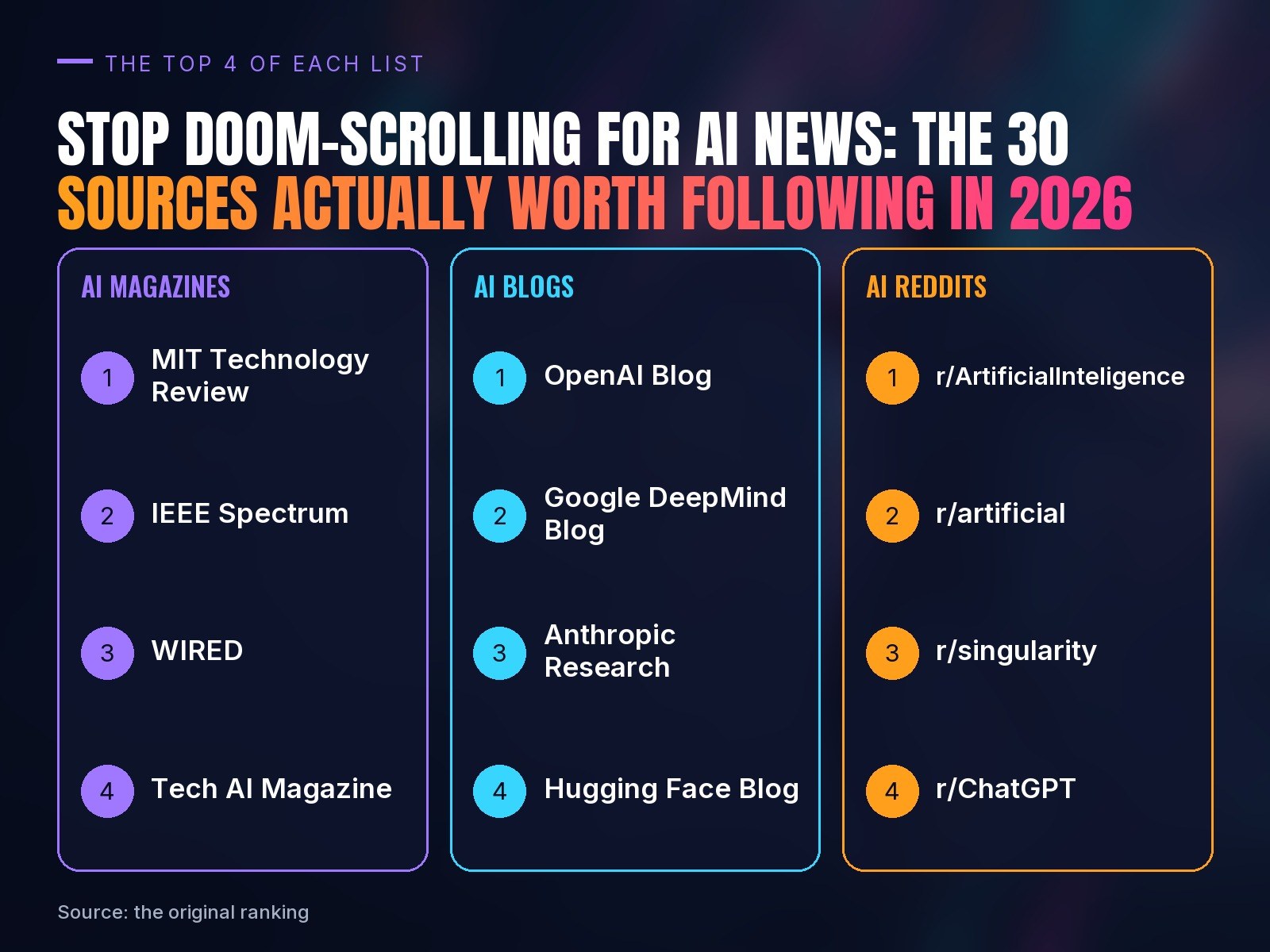
AI Magazines
1. MIT Technology Review
Still the most cited publication when someone wants to explain why a technical development matters beyond the industry. The AI coverage balances breakthrough reporting with societal consequences.
2. IEEE Spectrum
The go-to for readers who want engineering detail without academic jargon. Robotics and computing coverage is particularly strong, and the technical depth is unmatched among general-interest outlets.
3. WIRED
Readership is broad, which means WIRED often frames AI stories around culture and business rather than architecture. It's where a general audience goes when a model becomes a phenomenon.
4. Tech AI Magazine
Growing fast among developers who want open-source model updates and tool explainers without the wait. The technical tutorials are practical, and the publication doesn't assume you already know the acronyms.
5. Analytics Insight
Focuses heavily on machine learning research and data science applications. The industry news skews toward enterprise deployments and investment, less toward consumer products.
6. The Gradient
A smaller publication with outsized influence among researchers. The pieces are longer, the technical analysis is careful, and the perspective pieces challenge assumptions other outlets repeat.
7. AI Business Magazine
Enterprise leaders reading this are looking for governance frameworks, investment trends and case studies. The content is less about how models work and more about how companies deploy them.
8. Communications of the ACM
The audience is academic and professional computer scientists. AI coverage is rigorous, peer-informed and often arrives after the hype cycle has moved on—which is the point.
9. Technology Magazine
Broad digital transformation coverage with AI as one thread among many. Useful if you're tracking how AI adoption fits into larger enterprise technology decisions.
10. Analytics India Magazine (AIM)
The leading AI publication in India, covering local research, startups and policy alongside global developments. International readers should watch this for signal on where AI talent and infrastructure are growing.
AI Blogs
1. OpenAI Blog
Every post here moves the conversation. Model releases, safety research and product updates appear here first, and the framing often becomes the industry's framing within hours.
2. Google DeepMind Blog
The frontier research posted here is where breakthroughs are announced before they're explained elsewhere. Scientific discoveries and model architecture details set the agenda for technical discussions across platforms.
3. Anthropic Research
Claude updates and interpretability research define the content. The safety and alignment work published here is increasingly influential as the field debates what responsible AI development looks like.
4. Hugging Face Blog
The center of the open-source AI ecosystem. Model releases, developer tutorials and community contributions appear here faster than anywhere else, and the comment sections are often as valuable as the posts.
5. Simon Willison's Weblog
An independent blog that punches well above its size. Willison tests new models and tools the day they launch, and his practical experiments surface limitations and capabilities other coverage misses.
6. MarkTechPost
Rising quickly among readers who want research paper summaries and model release coverage without academic paywalls. The pace is high—multiple posts daily—and the technical detail is solid.
7. Towards Data Science
A go-to for applied AI tutorials and implementation guides. The contributor base is large, which means quality varies, but the best pieces are practical and immediately useful.
8. KDnuggets
Long-running data science and machine learning platform with a loyal following. The mix of tutorials, industry trends and tool comparisons appeals to practitioners more than researchers.
9. Machine Learning Mastery
Focused entirely on helping people implement machine learning techniques. The tutorials are step-by-step, the tone is patient, and the content assumes you're building something.
10. Sebastian Raschka's Ahead of AI
Technical deep dives into LLM architectures and training methods. Raschka's analysis is detailed, well-sourced and aimed at readers who want to understand how models are built, not just what they do.
AI Reddits
1. r/ArtificialInteligence
The largest general AI subreddit, with a mix of news, speculation and discussion. The signal-to-noise ratio is lower than smaller communities, but major developments surface here quickly.
2. r/artificial
Slightly more focused than r/ArtificialInteligence, with an emphasis on research applications and societal impact. The moderation keeps discussions more substantive than meme-heavy subreddits.
3. r/singularity
The most active community for frontier AI and AGI speculation. The tone is often breathless, but the subreddit catches major model releases and benchmark updates faster than most publications.
4. r/ChatGPT
Dominated by use cases, tips and product updates. The audience is broad—many users are casual—but the volume of posts means new features and workarounds are documented within minutes.
5. r/OpenAI
Focused specifically on OpenAI's models, APIs and product announcements. The community includes developers building on OpenAI tools, so the technical discussion is more detailed than r/ChatGPT.
6. r/MachineLearning
The most technical AI subreddit, with a strong research focus. Papers, benchmarks and implementation discussions dominate, and the moderation standards keep the quality high.
7. r/LocalLLaMA
The hub for open-source model enthusiasts running AI locally. Model comparisons, quantization techniques and hardware recommendations are discussed in detail, and the community moves fast.
8. r/ClaudeAI
A smaller community centered on Anthropic's Claude. The discussions cover features, workflows and model behavior, and the tone is less hype-driven than larger AI subreddits.
9. r/StableDiffusion
The center of the image generation community. Techniques, model updates and tool releases are shared and debated here before they appear in tutorials elsewhere.
10. r/AI_Agents
Emerging community focused on AI agents and automation frameworks. The discussions are practical—implementation details, framework comparisons, use cases—and the momentum is building as agent development accelerates.
The pattern across these sources is clear: speed matters more than it used to. Publications that can publish within hours of a release are gaining audience share from those that wait for the full story. Company blogs now break more news than most magazines. Reddit communities document new models before the official blog posts go live.
That doesn't mean long-form analysis is irrelevant. The magazines on this list still provide the context and critical perspective that blog posts and Reddit threads skip. But the reading habits are changing. More people are checking multiple sources daily—a company blog for the announcement, a subreddit for the first reactions, a magazine for the deeper take a week later.
The sources worth watching in 2026 are the ones that either move fast or add something no one else does. Everything else is catching up.