
I called up a friend who runs a small AI studio last week. He was trying to prototype a customer service bot that could read user screenshots, and he didn't want to manage three different APIs. 'I just need one place where I can throw a few things at the wall and see what sticks,' he told me.
That's the vibe on Hugging Face right now. This month's ranking highlights not just the most downloaded models, but the ones with fresh activity—tools that were updated within days, giving builders a shot at the latest tweaks. The question isn't what's popular in theory.
It's what you can actually run tonight.
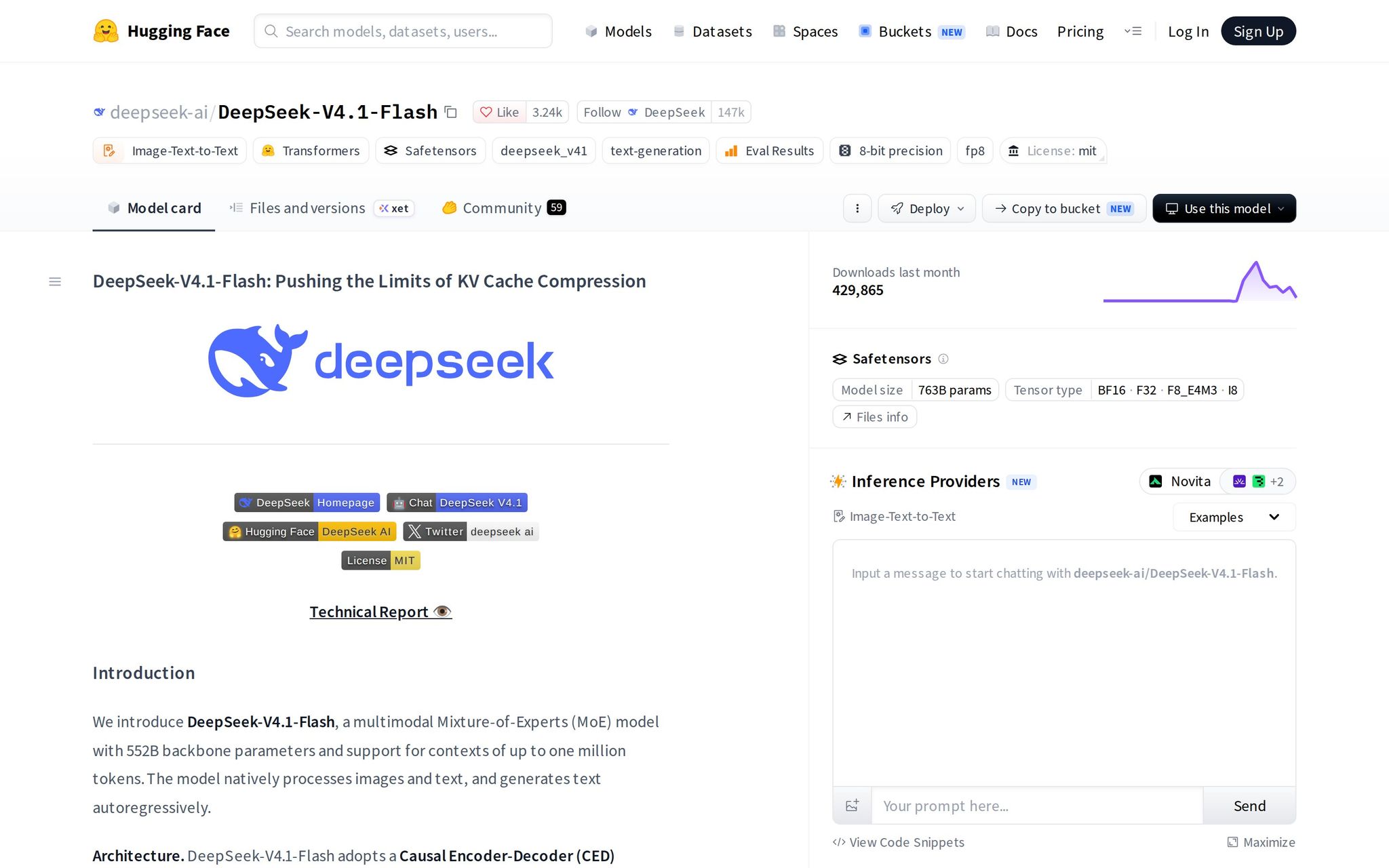
1. DeepSeek-V4.1-Flash
What It Does
This model lets you ask questions about pictures. Send it a product photo, a UI screenshot, or a diagram, and it'll generate a text description or answer. It's built for that specific task of understanding images and replying in words.
Why It's Trending
It tops the list with a trending score of 1,009, over 429,000 downloads, and was updated on September 10, 2026. The page is tagged for eight-bit and FP8 loading, which are two methods for running the model in a more compact, memory-efficient format.
Key Capabilities
- Understands images and answers questions about them.
- Generates text responses.
- Supports eight-bit quantization for smaller memory use.
- Supports FP8 quantization, another compact format.
- Works with hosted endpoints for easier deployment.
Best For
- Developers adding visual Q&A to an app.
- Builders prototyping multimodal assistants.
- Teams comparing different quantized model formats.
What Makes It Different
It's the only model here that combines image understanding with those specific eight-bit and FP8 compact-format tags, all under a permissive MIT license. The popular Qwen3.8-27B doesn't list those quantization options.
Hardware Requirements
Not published. The page confirms endpoint compatibility and the compact format tags, but doesn't state specific memory or GPU needs for local runs.
How to Try It
Go to the official model page. You can load it using the Transformers library or connect it through a compatible hosted endpoint. The page doesn't estimate setup time.
Things to Consider
- The MIT license allows broad reuse.
- You'll need to benchmark memory usage yourself.
- There are no published accuracy or safety results, so test it on your own images.
- While not tagged for custom code, full deployment details aren't specified.
Our Verdict
Start here if you're building a tool that needs to see. Just plan to validate every answer, because the community hasn't published how well it performs or where it fails.
Hugging Face: https://huggingface.co/deepseek-ai/DeepSeek-V4.1-Flash
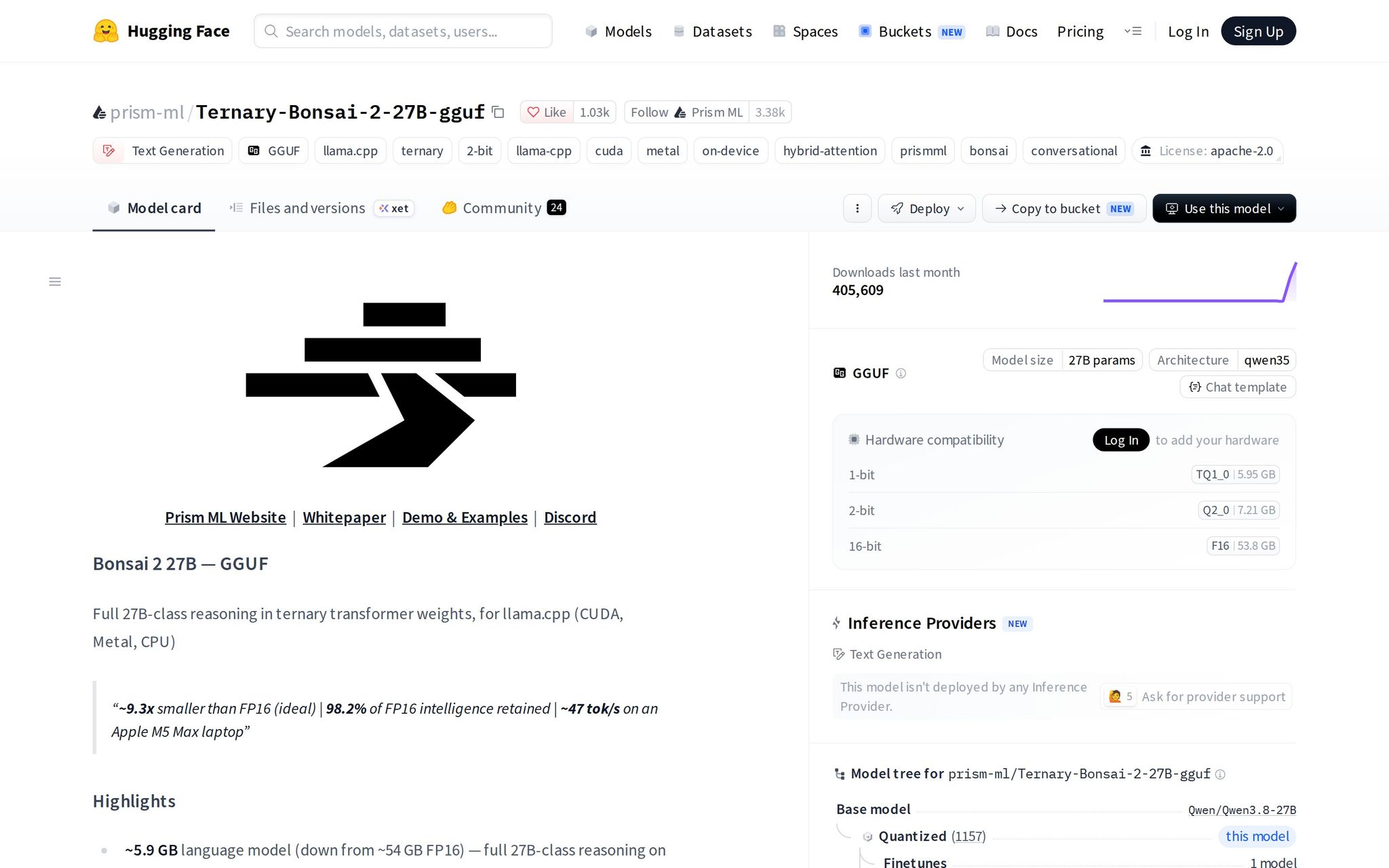
2. Ternary-Bonsai-2-27B-gguf
What It Does
This is a text generator packaged for local tools like llama.cpp. Its 'ternary' and 'two-bit' labels mean it's been compressed aggressively, ideal for testing a private chat tool on your own computer without sending data to a cloud service.
Why It's Trending
With a 980 trending score and over 405,000 downloads, it's near the top of the list and was updated on September 17, 2026—the freshest major model in this ranking.
Key Capabilities
- Generates text for answers or drafts.
- Packaged in the GGUF format for local software.
- Built for llama.cpp, a common local inference tool.
- Uses a highly compressed two-bit format.
- Tags suggest support for both Apple Metal and NVIDIA CUDA.
Best For
- Developers testing private, offline text tools.
- Builders comparing highly compressed model formats.
- Measuring the quality trade-off for massive memory savings.
What Makes It Different
Its two-bit and GGUF packaging is for developers who are counting every megabyte. MiniCPM5-2B is also for on-device use, but it's not tagged for this specific, ultra-compressed format.
Hardware Requirements
The page lists llama.cpp, CUDA, Metal, and on-device tags. Specific memory requirements aren't published, even with the compact format.
How to Try It
Download a GGUF file from the model page and load it in your llama.cpp software. The payload doesn't say how long setup takes.
Things to Consider
- Apache 2.0 license.
- You'll need to test memory use yourself.
- No published results on output quality or speed.
- Make sure you pick the right GGUF variant for your system.
Our Verdict
Try this if storage and privacy are your biggest constraints. Just don't assume two-bit compression keeps enough quality for your use case—you have to test that yourself.
Hugging Face: https://huggingface.co/prism-ml/Ternary-Bonsai-2-27B-gguf
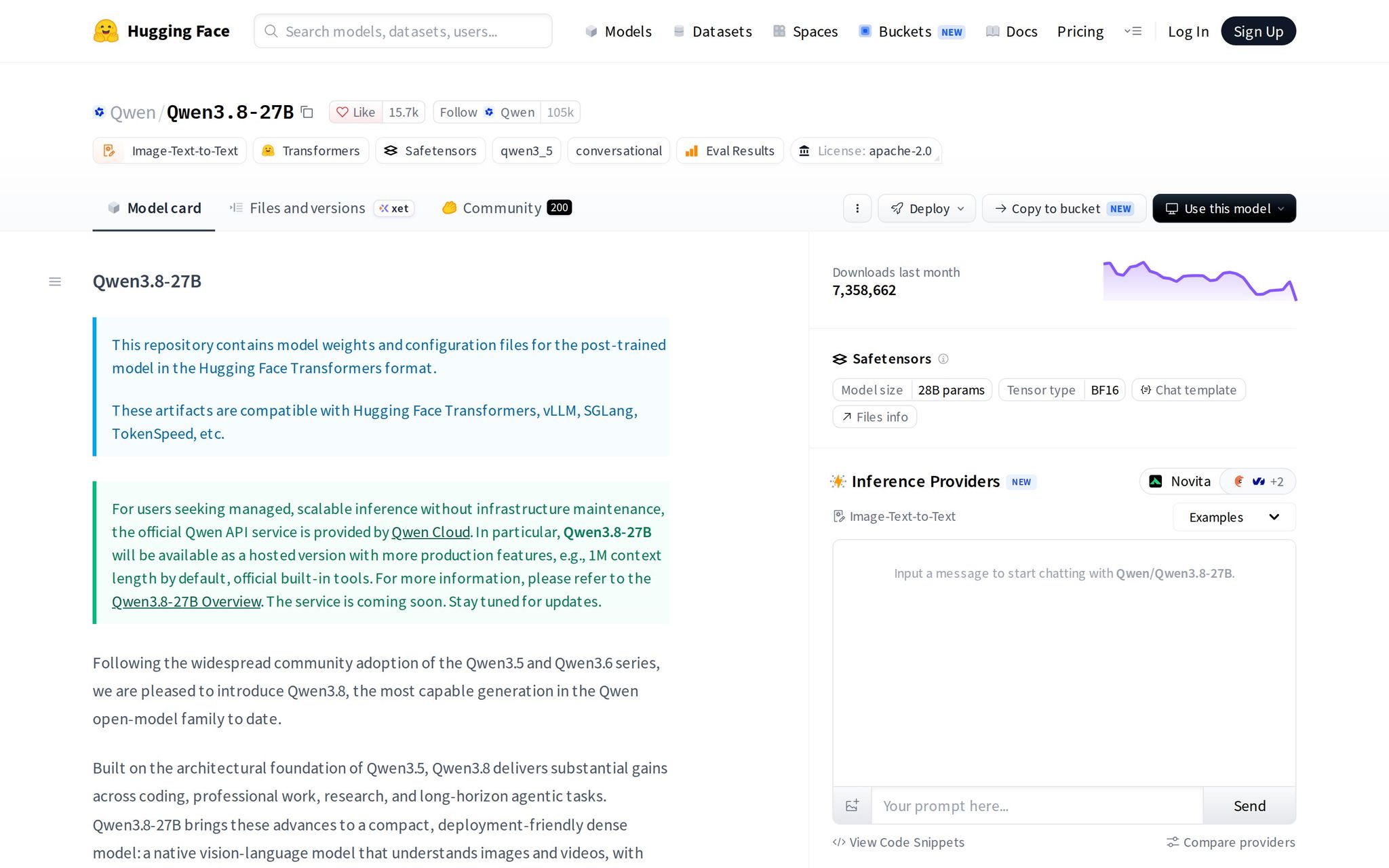
3. Qwen3.8-27B
What It Does
A conversational model that accepts both text and images. You can build a chat tool that explains a screenshot or answers questions about a photo. It's designed for that back-and-forth, multi-turn dialogue.
Why It's Trending
This is the usage champion: over 7.3 million downloads and 15,000 likes. It has a 612 trending score and was last updated on August 14, 2026, so its place comes from sustained adoption, not a recent spike.
Key Capabilities
- Accepts images as input for discussion.
- Generates conversational text replies.
- Supports multi-turn chat workflows.
- Compatible with hosted endpoints.
- The model page includes some evaluation results for review.
Best For
- Developers building visual chat prototypes.
- AI builders testing image-and-text workflows.
- Researchers comparing multimodal model behavior.
What Makes It Different
Its download numbers are an order of magnitude larger than the other multimodal models here. Unlike DeepSeek-V4.1-Flash, it uses an Apache 2.0 license and isn't tagged for those specific eight-bit or FP8 compact formats.
Hardware Requirements
Not published. The page supports endpoints but doesn't state what you'd need to run it locally.
How to Try It
Head to the official page and use the Transformers library or a compatible endpoint, as indicated by the tags. Setup time isn't documented.
Things to Consider
- Apache 2.0 license.
- Local hardware needs are unknown.
- No independent data on its accuracy, speed, or safety.
- It hasn't been updated since mid-August 2026.
Our Verdict
This is your starting point if you want a community-tested chat model that can see. Treat the massive download count as a sign of interest, not a guarantee it'll fit your cost, quality, or safety requirements.
Hugging Face: https://huggingface.co/Qwen/Qwen3.8-27B
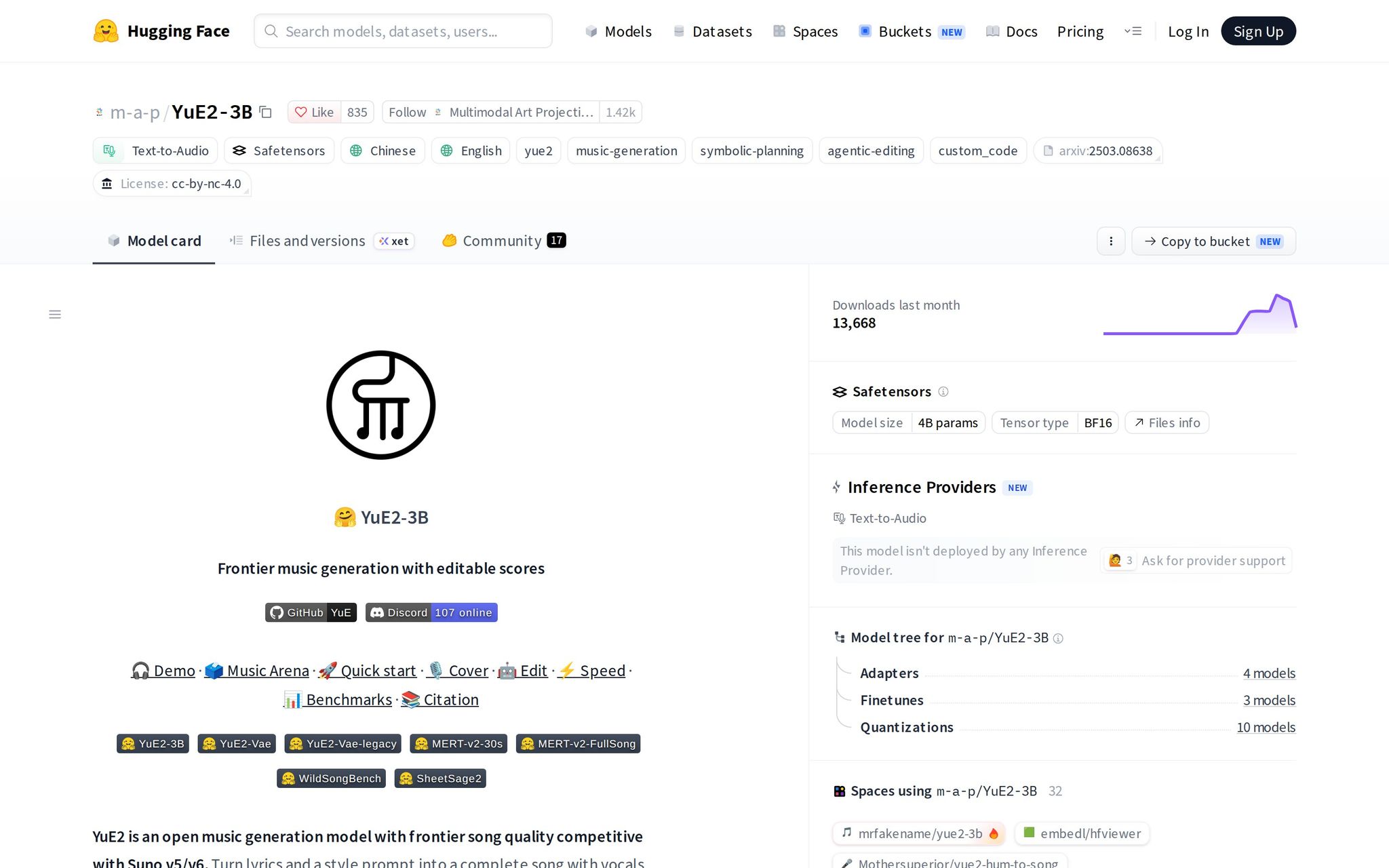
4. YuE2-3B
What It Does
This model turns text instructions into audio, with a focus on music generation. The 'symbolic-planning' and 'agentic-editing' tags suggest it can plan a musical structure and then revise it based on feedback, rather than just creating a single, static clip.
Why It's Trending
It has a 532 trending score and was updated on September 16, 2026. With about 13,600 downloads, its audience is smaller than the text models, but the recent update and music niche make it stand out.
Key Capabilities
- Generates audio from text prompts.
- Focuses on creating original music.
- Uses symbolic planning to organize structure.
- Allows for instruction-guided edits.
- Supports prompts in English and Chinese.
Best For
- AI builders prototyping music composition tools.
- Students learning audio-generation workflows.
- Experimenting with planned versus direct generation.
What Makes It Different
It's for making and editing music. The other audio model here, AuK, is all about speech—cloning voices, editing dialogue, and separating audio sources.
Hardware Requirements
Not published. The page has safetensors and custom-code tags but no memory target.
How to Try It
Open the model page and inspect its text-to-audio files and instructions. The payload doesn't point to a specific app or estimate setup time.
Things to Consider
- The license is CC BY-NC 4.0, which prohibits commercial use.
- You'll need to figure out the hardware requirements.
- The page has a custom-code tag, so integration might need more work.
- There's no published data on output quality or safety.
Our Verdict
A solid tool for learning and non-commercial music prototypes. That noncommercial license means you can't build a product with it.
Hugging Face: https://huggingface.co/m-a-p/YuE2-3B
5. LTX-2.5
What It Does
This model creates or transforms video and audio. Give it a picture and a description of movement, and it can generate a short video clip. It can also convert between media types, like turning audio into a video or extracting audio from a video.
Why It's Trending
It has over 1.6 million downloads and a 421 trending score, updated on September 1, 2026. The page lists an unusually wide range of conversions, which draws experimenters.
Key Capabilities
- Generates video from text descriptions.
- Animates a still image into a video.
- Transforms existing video into new video.
- Creates video from an audio track.
- Extracts audio from a video source.
Best For
- AI builders prototyping audiovisual generation pipelines.
- Developers testing complex media workflows.
- Experimenting with different input and output combinations.
What Makes It Different
Its model page claims capabilities in nearly every direction: text, image, video, and audio conversions. MiniMax-H3 also spans video and audio but has a much lower trending score and less demonstrated breadth.
Hardware Requirements
Not published. The page lists diffusion-single-file packaging but no memory or device targets.
How to Try It
Go to the official page and follow the instructions for its image-to-video, text-to-video, or other paths. Setup time isn't published.
Things to Consider
- License is listed vaguely as 'other'—check the terms carefully.
- Memory and hardware needs are unknown.
- No published results on output quality or generation speed.
- Having many conversion tags doesn't mean they all work equally well.
Our Verdict
If you need one model to test several types of media generation, start here. Then immediately check the license and see what a minute of generated video actually costs to produce.
Hugging Face: https://huggingface.co/Lightricks/LTX-2.5
6. MiniCPM5-2B
What It Does
A small conversational model that can also do 'tool calling'—meaning it can request an outside function, like looking up a weather report, instead of just replying with text. It's tagged for on-device use and long conversations.
Why It's Trending
With over 357,000 downloads and updated on September 12, 2026, it has a 329 trending score. The mix of on-device, long-context, and tool-calling tags targets practical application building.
Key Capabilities
- Generates conversational text.
- Can call external tools or functions.
- Works with long text inputs.
- Designed for on-device (local) deployment.
- Built for English-language interactions.
Best For
- Developers wiring AI assistants to app functions.
- Builders prototyping local, private chat tools.
- Students learning how tool-calling works.
What Makes It Different
It's explicitly built for tool calling and local use. Llama-3.1-8B-Instruct has high usage but isn't tagged for those features in this data. The '2B' in its name hints it's a smaller model, but that's not a quality rating.
Hardware Requirements
Tagged for on-device use, but specific memory and processor needs aren't published.
How to Try It
Open the model page and load it using the Transformers library, which the tags indicate. Setup time isn't published.
Things to Consider
- Apache 2.0 license.
- On-device support is claimed, but requirements are unknown.
- No data on how reliably it uses tools or its safety.
- The page lists English, so performance in other languages is untested.
Our Verdict
Pick this if you're learning to connect chat to functions and want to run it locally. Just put strict validation around every tool call before you let it run.
Hugging Face: https://huggingface.co/openbmb/MiniCPM5-2B
7. Edge0-35B-A3B-preview
What It Does
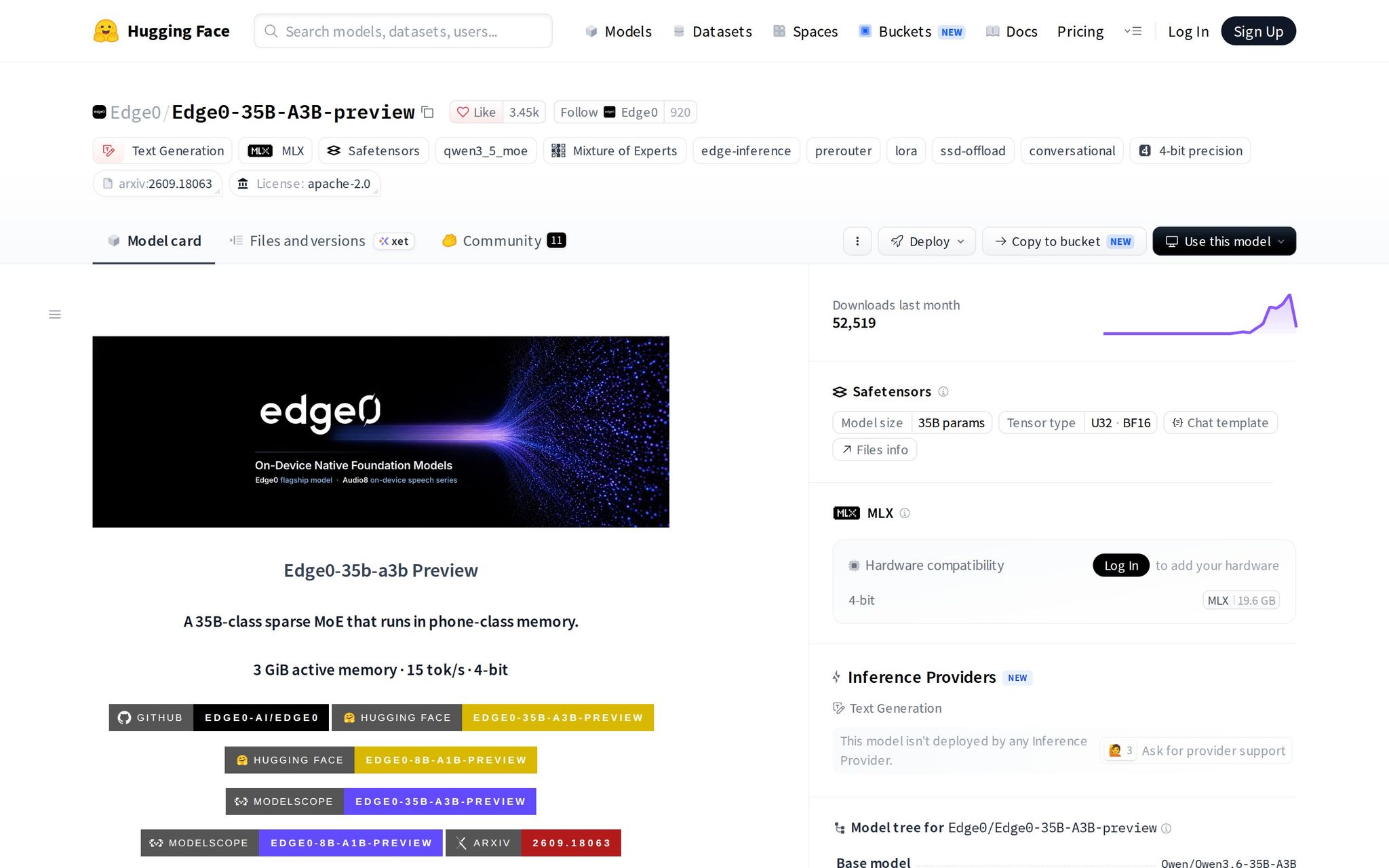
A preview model for 'edge inference'—running AI locally on a device like a laptop or phone, closer to the user. Its tags point to techniques for making this feasible: four-bit compression, SSD offloading (using disk as extra memory), and LoRA support for efficient fine-tuning.
Why It's Trending
Updated September 17, 2026, it has a 240.2 trending score. It has a high number of likes (3,447) relative to its 52,500 downloads, signaling strong early interest in a preview model.
Key Capabilities
- Generates conversational text.
- Designed for edge/local inference.
- Uses a compact four-bit numeric format.
- Supports SSD offloading to manage memory.
- Works with LoRA, a method for efficient model adaptation.
Best For
- Developers prototyping assistants that run on-device.
- AI builders testing local memory trade-offs.
- Comparing four-bit and disk-offloaded performance.
What Makes It Different
It's explicitly built for the edge, with tags for offloading and four-bit formats. Ternary-Bonsai is also compact, but focuses on two-bit GGUF files. Also, this one is clearly labeled a preview.
Hardware Requirements
Tagged for edge inference, four-bit, and SSD-offload. Exact memory requirements aren't published.
How to Try It
Open the official page and inspect its Transformers or MLX files. Setup time isn't published.
Things to Consider
- Apache 2.0 license.
- Offloading can seriously impact speed, but no benchmarks are given.
- It's a preview, so its behavior could change.
- No independent results on output quality or safety.
Our Verdict
A promising sandbox for testing local deployment. The preview label and missing performance data mean you should benchmark it thoroughly before building anything you rely on.
Hugging Face: https://huggingface.co/Edge0/Edge0-35B-A3B-preview
8. laya
What It Does
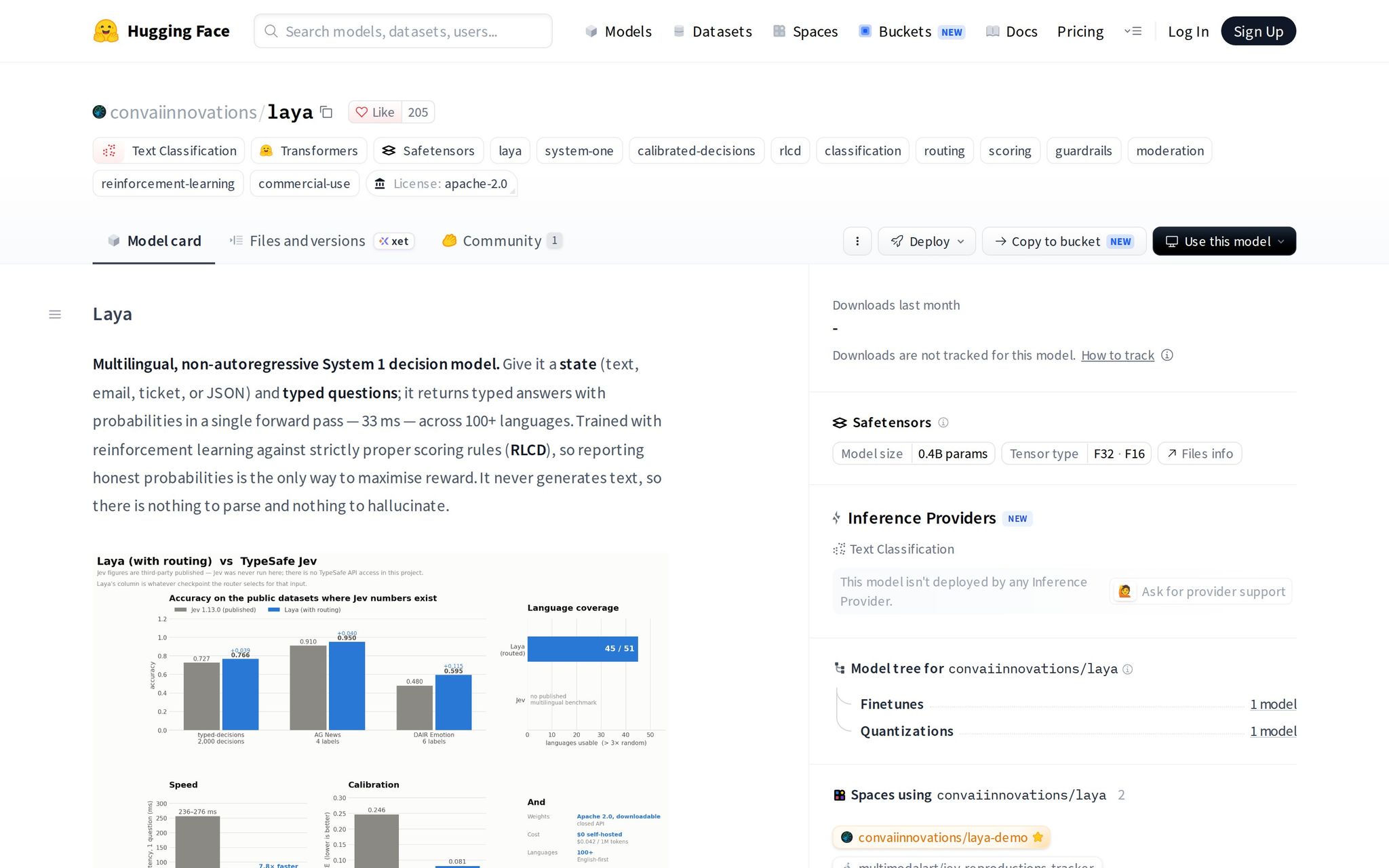
This is a text classifier. It can read incoming text and score it, categorize it, or decide where to route it. The tags connect it to moderation, guardrails, and calibrated decisions—useful for screening user content or adding safety checks to an AI system.
Why It's Trending
It was updated on September 19, 2026, the newest model in this list. It has a 202 trending score and 205 likes, but reports zero downloads. Its momentum is all from recent attention, not proven use.
Key Capabilities
- Classifies text into categories.
- Routes items to different processes.
- Scores or ranks incoming text.
- Can be used for content moderation.
- Acts as a guardrail for AI systems.
Best For
- Developers adding moderation or routing checks to an app.
- AI builders testing guardrail workflows.
- Researchers studying calibrated classification.
What Makes It Different
It's for making decisions about text, not conversing. The other text model here, all-MiniLM-L6-v2, finds similar meanings for search. Laya is built to judge and route.
Hardware Requirements
Not published. The page lists Transformers and safetensors tags.
How to Try It
Open the official page and load the text-classification model with the Transformers library. Setup time isn't published.
Things to Consider
- Apache 2.0 license.
- Zero reported downloads means it's completely unproven in the wild.
- Any moderation output needs to be checked before you enforce it.
- No published data on its classification accuracy or calibration.
Our Verdict
Worth a look if you're building a moderation system from scratch. But with zero downloads, you must run your own labeled tests—you can't trust it blind.
Hugging Face: https://huggingface.co/convaiinnovations/laya
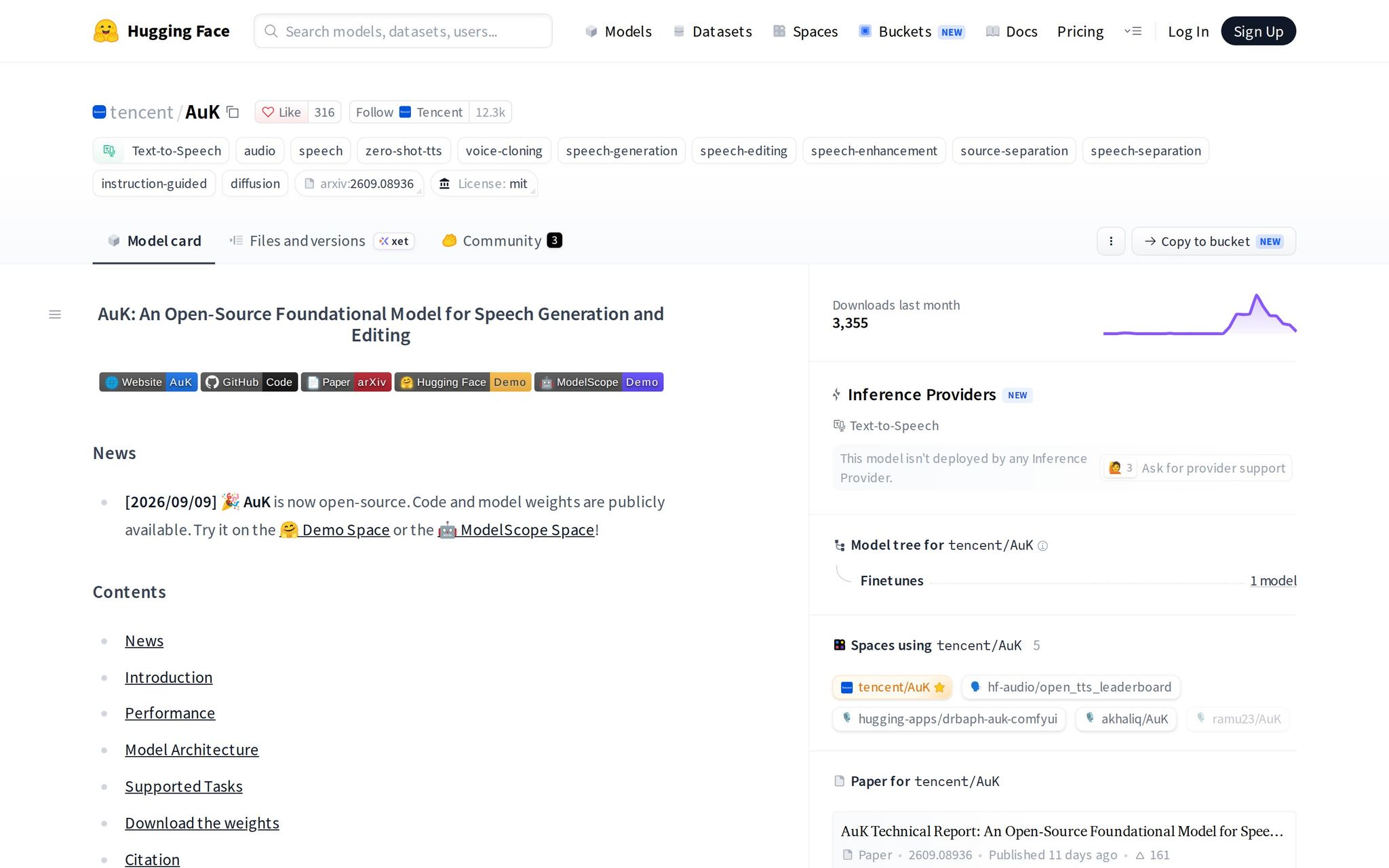
9. AuK
What It Does
A speech model. It turns text into spoken audio, can clone a voice from a sample, and also edit, enhance, or separate audio sources. It's for building or modifying spoken audio, not music.
Why It's Trending
Updated on September 10, 2026, it has a 198 trending score. With about 3,100 downloads, its audience is smaller than YuE2-3B's, but its focus on speech tasks carves out a distinct niche.
Key Capabilities
- Converts text to speech.
- Clones a voice from a sample.
- Edits existing spoken audio.
- Enhances audio quality.
- Separates different sounds or voices in a track.
Best For
- Developers prototyping spoken interfaces or audiobooks.
- AI builders testing voice transformation workflows.
- Experimenting with speech editing and source separation.
What Makes It Different
It's all about spoken audio and audio repair. YuE2-3B, the other audio model, is for composing and editing music.
Hardware Requirements
Not published. The page lists a diffusion tag but no device, memory, or endpoint target.
How to Try It
Go to the official model page and follow its text-to-speech or speech-editing instructions. Setup time isn't published.
Things to Consider
- MIT license.
- Hardware requirements are unknown.
- Voice cloning creates serious consent and identity risks—the payload lists no safeguards.
- No published results on speech quality, separation accuracy, or cloning fidelity.
Our Verdict
A focused tool for audio developers. If you use the cloning feature, get explicit permission for every voice sample, and check the outputs for quality and potential misuse.
Hugging Face: https://huggingface.co/tencent/AuK
10. all-MiniLM-L6-v2
What It Does
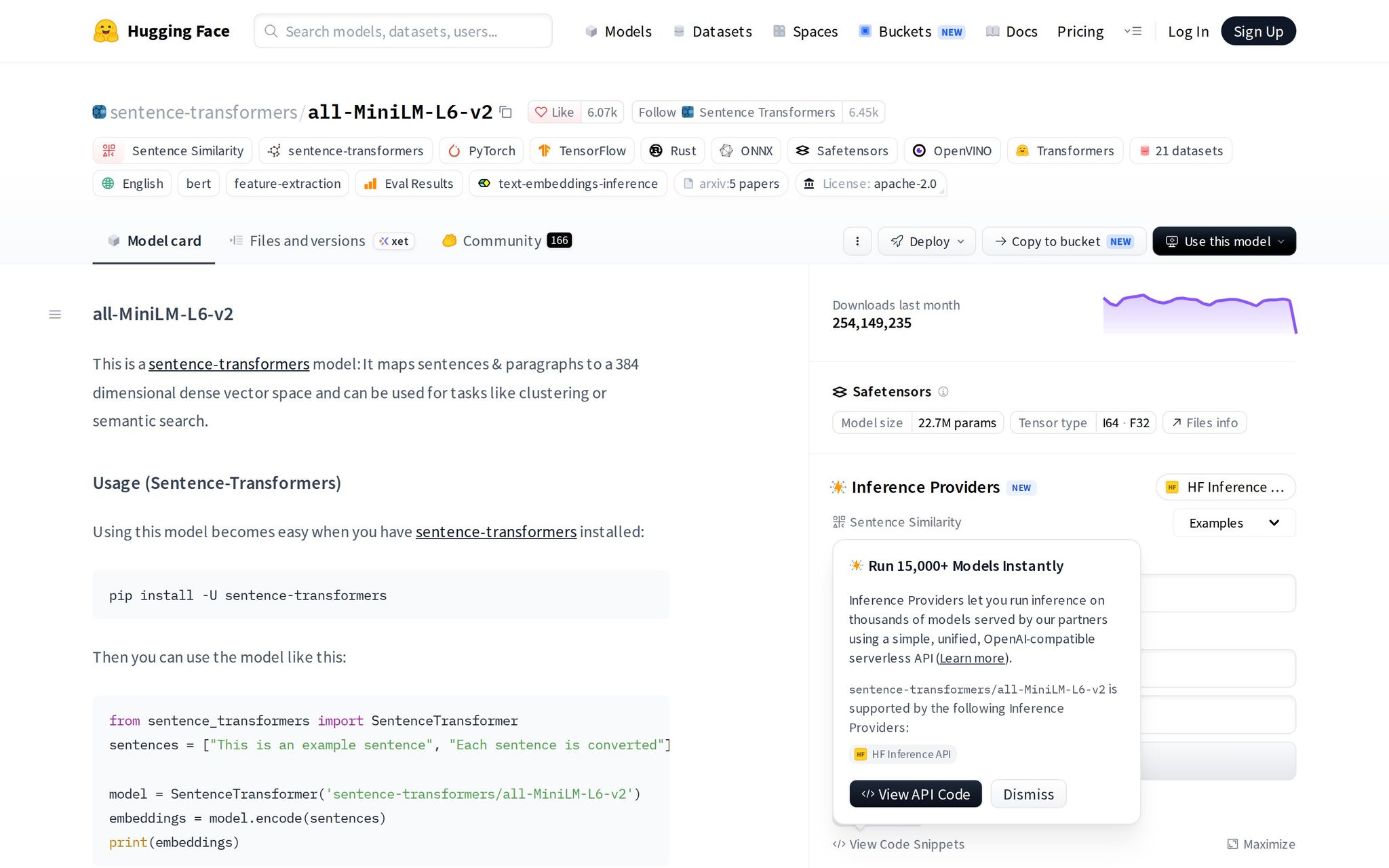
This model turns sentences into numerical 'fingerprints' (called embeddings) that represent their meaning. You can compare these fingerprints to find similar customer questions, search a document library, or group related text—it's the engine behind semantic search.
Why It's Trending
The slow-burn workhorse. It has a staggering 254 million downloads and was updated on June 1, 2026. Its 184 trending score is low, but its support for PyTorch, TensorFlow, Rust, ONNX, and OpenVINO keeps it relevant in almost any deployment pipeline.
Key Capabilities
- Finds sentences with similar meanings.
- Turns text into numerical vectors for processing.
- Powers semantic search over documents.
- Offers a Rust deployment path.
- Supports ONNX and OpenVINO runtime formats.
Best For
- Developers building document or support ticket search.
- Researchers comparing sentence representation methods.
- Students learning how meaning-based search works.
What Makes It Different
Its download count is in a different universe, and it supports more runtimes than anything else here. Laya classifies text; this model finds text that's semantically similar.
Hardware Requirements
Not published. The page lists support for PyTorch, TensorFlow, Rust, ONNX, and OpenVINO.
How to Try It
Open the model page and use the Sentence Transformers library or any of its listed runtimes. Setup time isn't published.
Things to Consider
- Apache 2.0 license.
- Specific memory needs aren't published.
- Remember: similar meaning is not the same as factual correctness.
- The page lists English, so performance in other languages isn't guaranteed.
Our Verdict
This is your default choice for adding semantic search. It's proven and portable. Just don't let the search results go unchecked—similarity doesn't mean the answer is right.
Hugging Face: https://huggingface.co/sentence-transformers/all-MiniLM-L6-v2
The trend isn't one killer model. It's specialization. Multimodal chat is still the busiest corner, but now you have credible, updated options for audio, video, local inference, moderation, and search.
The playbook stays the same: start with the smallest experiment that fits the job. Test the license, see if it runs on your hardware, and find its failure cases. Only then should you turn that early momentum into something you depend on.