
Consider, for a moment, the outfitters who provisioned the Klondike gold rush. The real opportunity in a stampede is seldom the thing everyone is chasing. It is selling the shovels.
This month’s collection surveys the current landscape of AI-enabled shovels, with the caveat that most are still more pick than pan. They are specific, often early, and sometimes cheap enough to try. The one thing they are not is a route to passive income.
That particular alchemy remains as elusive as ever.
1. AI Voice Agent for Property Management

What It Does
This business deploys a voice assistant for property managers and individual properties. It answers tenant and guest calls, handles alerts, sends WhatsApp notifications, and escalates issues. The pitch is simple: round-the-clock first-line coverage without staffing every call.
Why It's Trending
The capability has become newly practical for smaller portfolios. Current offers start at €10 per property per month. Market guides also cite $400–$2,500 monthly portfolio deployments, putting a once-enterprise-shaped service within reach of smaller operators.
How It Works
- > Customer Problem: Missed calls and repetitive tenant questions consume property managers’ time.
- > AI Solution: Configure an AI voice agent with telephony, speech-to-text, and escalation rules.
- > Deliverable: A live answering service with alerts, WhatsApp notifications, and human hand-offs.
- > Customer Acquisition: Approach property-management companies with a narrowly defined call-flow demonstration.
- > Revenue Model: Charge for setup and ongoing management of the hosted service and its usage.
Best For
- > Entrepreneurs deploying call handling for small property portfolios
- > Small businesses reducing repetitive tenant enquiries
- > AI professionals integrating telephony and escalation workflows
What Makes It Different
The niche is operational, not conversational. This is about leasing, alerts, and tenant support, not a generic chatbot wearing a headset. The low entry price makes a small-portfolio offer plausible, though minute-based economics leave little room for sloppy routing.
Getting Started
- > Skills: Property-management workflow knowledge, call-flow design, and basic AI/telephony setup.
- > AI Tools: An AI voice-agent platform with telephony, LLM, and speech-to-text.
- > Initial Setup: Configure property-specific information, alert paths, and human escalation.
- > First Customer: A property manager already drowning in repetitive calls.
- > Delivery Model: A hosted, usage-based voice service with continuous monitoring.
Revenue Model
Service — published pricing includes €10/month per property with 60 minutes and €0.25/minute thereafter; market guides cite $400–$2,500/month for portfolio deployments.
Things to Consider
- > Startup Cost: Hosted pricing starts at €10/month per property, with overages; larger deployments are cited at $400–$2,500/month.
- > Competition: The market is early but already has multiple pricing pages and comparison guides.
- > AI Dependency: Platform dependence and minute-based costs can compress margins.
- > Customer Acquisition: Clients expect human-level coverage, so the escalation design must be demonstrated.
- > Scalability: Wrong escalation rules create service-quality risk across every property.
Our Verdict
A practical fit for entrepreneurs with property-management contacts who can sell reliable escalation, not the fantasy that an AI understands every tenant emergency.
2. Productized AI Automation Services

What It Does
This is a fixed-scope implementation business for small and mid-sized companies that want AI workflows without hiring an internal team. The operator builds a defined automation, RAG system, or agent pipeline. They then supply monitoring, fallbacks, and human review.
The client gets a working system, not an impressive demo and a disappearing act.
Why It's Trending
In 2026, agencies have begun packaging AI work into repeatable offers with monitoring and review gates. The change is less a scientific breakthrough than a commercial one. Buyers can now purchase a bounded service instead of an open-ended experiment.
How It Works
- > Customer Problem: A business has a repetitive workflow but no in-house implementation capacity.
- > AI Solution: Design a fixed workflow using agents or RAG, with monitoring and fallback paths.
- > Deliverable: A documented, deployed automation package with review gates.
- > Customer Acquisition: Sell one narrow use case to small and mid-sized businesses rather than ‘AI transformation’.
- > Revenue Model: Price the defined implementation and any continuing service separately.
Best For
- > Freelancers turning bespoke automation work into repeatable packages
- > Entrepreneurs building a specialist implementation agency
- > Small businesses adopting one workflow without hiring internally
- > AI professionals delivering monitored agent and RAG systems
What Makes It Different
The product is the boundary. Fixed scope, repeatable delivery, and explicit failure handling make it more sellable than general consultancy. Standardisation, however, also makes it easier for competitors to imitate.
Getting Started
- > Skills: Workflow design, implementation, and client delivery.
- > AI Tools: AI agents, RAG systems, monitoring, and fallback pipelines.
- > Initial Setup: Define one workflow, its inputs, a review gate, failure modes, and acceptance criteria.
- > First Customer: A small or mid-sized business with one expensive, repetitive process.
- > Delivery Model: A fixed-scope implementation followed by optional monitoring and maintenance.
Revenue Model
Consulting — no published rates.
Things to Consider
- > Competition: Productized AI services are rising as agencies standardise similar offers.
- > Customer Acquisition: The buyer must understand a specific business outcome, not merely the machinery.
- > AI Dependency: Fallbacks and human review are necessary because unattended outputs remain a liability.
- > Scalability: Scope creep can destroy the economics of a supposedly repeatable package.
Our Verdict
A sensible route for experienced freelancers who can define boundaries before writing code. Its deciding challenge is resisting bespoke requests until the product stops being productized.
3. AI Answer Engine Optimization Service
What It Does
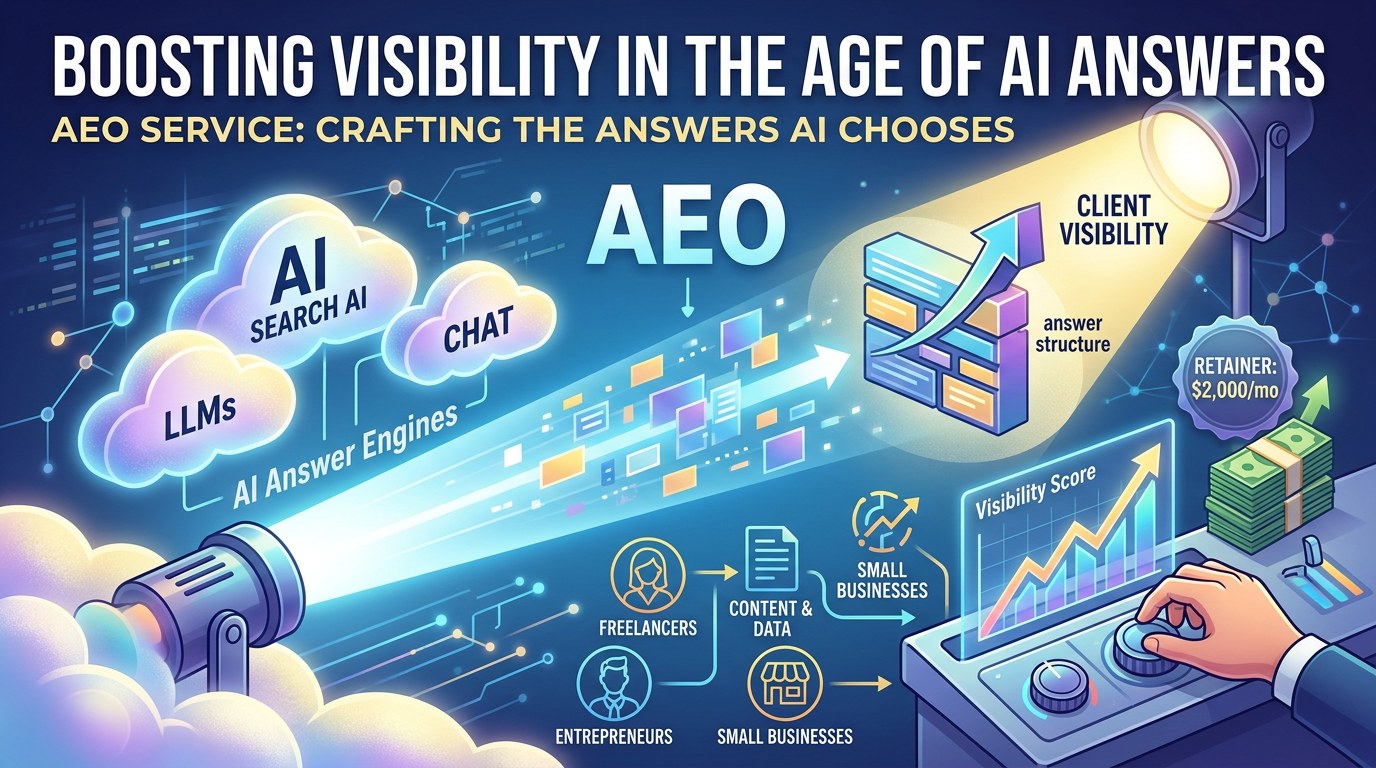
An AEO service helps businesses improve their chances of being surfaced in AI search and answer systems. The seller audits a company’s information and produces optimisation work aimed at making its products or expertise easier for those systems to retrieve.
Why It's Trending
A reported case published in July 2026 described AEO as an AI-era service category and cited one client paying a $2,000 monthly retainer. That is one case, not a market average, but it is recent evidence that some buyers will attach budget to the problem.
How It Works
- > Customer Problem: A business wants visibility when customers ask AI systems for recommendations.
- > AI Solution: Apply AI search and answer optimisation workflows to the company’s information.
- > Deliverable: An optimisation programme aimed at improving representation in answer engines.
- > Customer Acquisition: Use a visibility audit to approach businesses already concerned about AI search.
- > Revenue Model: Retainer-based service, with one reported client at $2,000 per month.
Best For
- > Freelancers selling a focused search-visibility audit
- > Entrepreneurs building an early specialist service
- > Small businesses improving representation in AI answers
- > AI professionals analysing answer-engine behaviour
What Makes It Different
Unlike ordinary copywriting, the service is sold against a new discovery surface: AI answers rather than ranked web pages. Its commercial evidence is unusually specific but thin, which is precisely why it ranks here rather than higher.
Getting Started
- > Skills: AI search and answer optimisation workflows; other skills were not verifiable in the source.
- > AI Tools: AI search and answer optimisation workflows.
- > Initial Setup: Define an audit and reporting process for a client’s AI-search visibility.
- > First Customer: A business already worried about discovery in AI answer systems.
- > Delivery Model: An ongoing optimisation retainer.
Revenue Model
Consulting — one reported case cited a $2,000/month retainer from one client.
Things to Consider
- > Competition: The source does not establish how saturated the category is.
- > Customer Acquisition: Buyers may need education before they recognise AEO as a budget line.
- > AI Dependency: Search behaviour can change, weakening the value of a fixed optimisation playbook.
- > Scalability: Clients can insource the work once the process is understood.
Our Verdict
A speculative but testable option for freelancers with search expertise and a tolerance for changing rules. Success depends on showing client-specific visibility evidence, not selling a fashionable acronym.
4. AI Seller Assist

What It Does
AI Seller Assist is software for resellers and flippers that generates listings while tracking costs, locations, and labels. A seller can use it on existing inventory to reduce the clerical work of publishing items. The caveat is simple: you still have to verify what the item actually is before it reaches a marketplace.
Why It's Trending
Low current pricing makes the model accessible to solo operators. Published plans run from $8 a month to $300 a month for an on-premise server plan. This is not a new invention so much as a meaningful reduction in the cost of automating small-scale resale operations.
How It Works
- > Customer Problem: Resellers spend time writing listings, tracking costs, and preparing labels.
- > AI Solution: Generate listing content while connecting it to cost, location, and label tools.
- > Deliverable: A working listing and inventory workflow for resale stock.
- > Customer Acquisition: Target e-commerce resellers, flippers, and small online sellers with existing inventory.
- > Revenue Model: Subscription tiers matched to seller and reseller volume.
Best For
- > Entrepreneurs operating a small flipping business
- > Small businesses managing online resale inventory
- > Freelancers setting up listing workflows for resellers
What Makes It Different
The opportunity is not merely generated copy. It combines listing creation with operational details that affect resale margins. The low starter price helps adoption, although the same tool can make competitors faster too.
Getting Started
- > Skills: E-commerce listing operations, inventory basics, and careful item verification.
- > AI Tools: AI listing generation, cost tracking, location tracking, and label tools.
- > Initial Setup: Connect the subscription workflow to existing inventory and selling routines.
- > First Customer: A reseller already publishing enough items to feel the administrative burden.
- > Delivery Model: Self-serve subscription, or setup assistance around the software.
Revenue Model
Product — published plans are $8/month starter, $35/month flipper, $210/month reseller and $300/month server; another reseller-oriented page lists €9 one-time, €25/month and €49/month plans.
Things to Consider
- > Competition: Multiple current pricing pages target resellers and flippers.
- > Customer Acquisition: The product only matters to sellers with enough inventory or listing volume.
- > AI Dependency: Output-quality problems can put incorrect item details into a marketplace.
- > Scalability: Thin resale margins leave little tolerance for subscription and correction costs.
- > Startup Cost: Entry pricing is $8/month, but higher-volume operation requires $210 or $300 plans.
Our Verdict
A reasonable fit for small resellers who already have inventory and can check every generated detail. It’s less convincing for anyone hoping software alone will create a profitable stock pipeline.
5. AI Listing Assistant for Real Estate

What It Does
This business provides tools or a productized service that turns property information into listing copy and related broker lead alerts. The customers are estate agents, brokers, and listing teams who want faster publishing. They retain responsibility for local MLS and brokerage compliance.
Why It's Trending
Dedicated listing products now offer low-cost subscriptions, including $9.99 a month on a consumer app and web plans from $0 to $99 a month. The recent shift is commercial packaging: agents can buy a specialised workflow rather than assemble one from a general-purpose model.
How It Works
- > Customer Problem: Agents need listing copy and lead alerts without spending every launch on drafting.
- > AI Solution: Use agent-specific listing-generation software and workflows.
- > Deliverable: Property listing copy plus related broker lead alerts.
- > Customer Acquisition: Approach agents, brokers, and listing teams with a compliant sample workflow.
- > Revenue Model: Subscription or productized service around low-cost listing tools.
Best For
- > Freelancers providing listing support to local agents
- > Small businesses serving a brokerage or listing team
- > Entrepreneurs reselling a focused real-estate workflow
What Makes It Different
The niche is the property-listing workflow, not generic marketing copy, and reseller plans create room for a service layer. The difficulty is obvious: agents can buy similar software themselves for very little.
Getting Started
- > Skills: Listing copywriting, basic real-estate marketing, and local MLS or brokerage-rule awareness.
- > AI Tools: AI listing-generation software and agent-specific listing workflows.
- > Initial Setup: Build compliant templates and a review process for local listing requirements.
- > First Customer: An agent or broker already producing multiple listings.
- > Delivery Model: Self-serve subscription, assisted service, or a reseller arrangement.
Revenue Model
Service — published rates include $9.99/month, $0/$45/$99 per month, and €9 one-time, €25/month or €49/month plans.
Things to Consider
- > Competition: Several current products target the same workflow, making the category moderately saturated.
- > Customer Acquisition: Agents may bypass the service and subscribe directly.
- > AI Dependency: Generated copy still needs brokerage and MLS compliance checks.
- > Scalability: More clients mean more responsibility for correcting inaccurate property details.
Our Verdict
Best suited to freelancers with local brokerage relationships. The opportunity survives only if compliance, editing, and responsiveness justify a fee above the software subscription.
6. Indie Hacker AI Product Building
What It Does
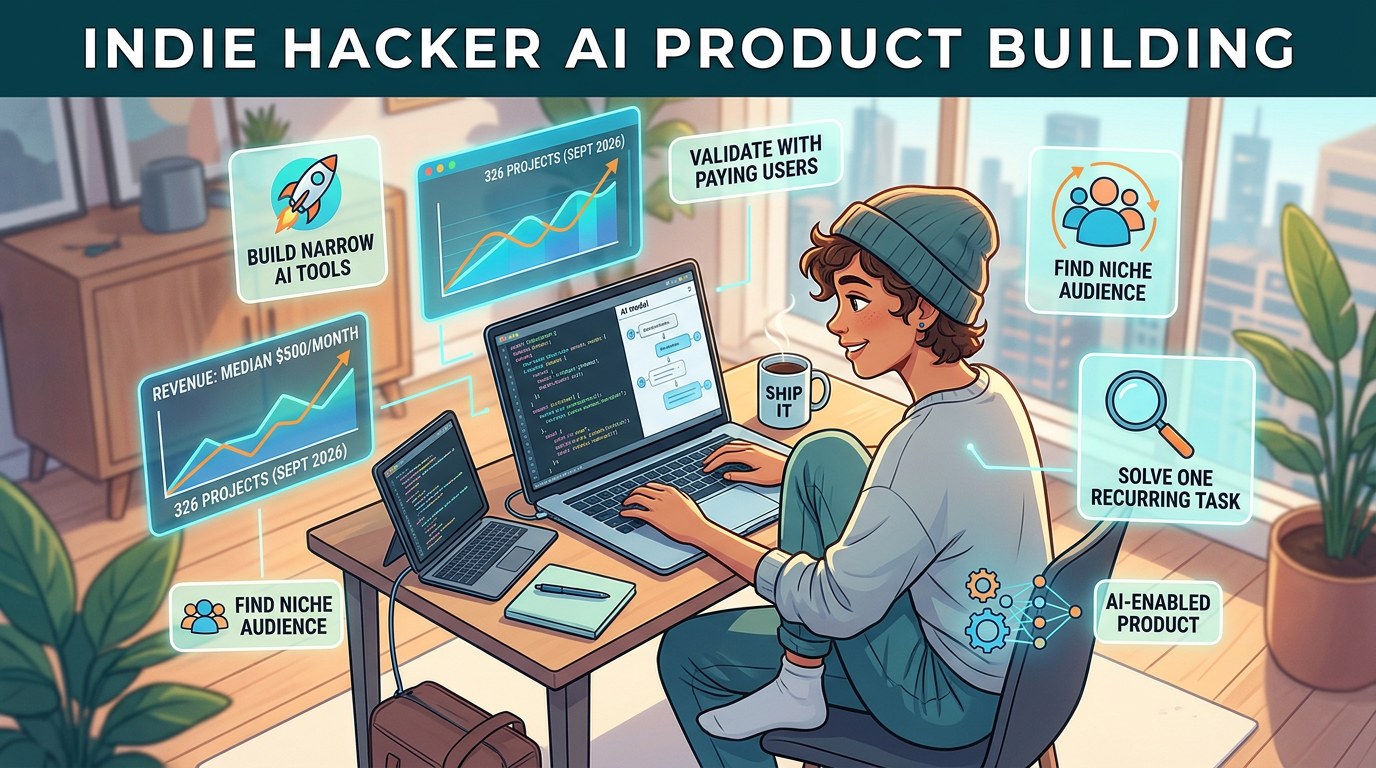
This is the familiar solo-founder business, narrowed to small AI software products and services for end users or small businesses. The product might solve one niche task. The sale is still software access or a compact service, not a vague promise to ‘build in public’ until attention becomes money.
Why It's Trending
A revenue report was updated in August 2026, while a September 2026 build-in-public study reported a median revenue of $500 a month across 326 indie projects. That is current evidence of paid activity, not evidence that the median project is a comfortable livelihood.
How It Works
- > Customer Problem: A narrow user group lacks a convenient tool for one recurring task.
- > AI Solution: Build a small software product or service around that task.
- > Deliverable: A paid niche product used by end users or small businesses.
- > Customer Acquisition: Reach a direct audience or use platform distribution.
- > Revenue Model: Product or service revenue from the niche audience.
Best For
- > Entrepreneurs testing a narrow software product
- > Developers shipping a small AI-enabled tool
- > Students validating a focused project with paying users
What Makes It Different
The advantage is speed and focus: a solo founder can target a small problem without building a conventional software company. The disadvantage is equally direct. Three hundred and twenty-six projects and a $500 monthly median describe a crowded, uneven field.
Getting Started
- > Skills: The available sources do not verify a specific skill set.
- > AI Tools: The available sources do not verify particular tools.
- > Initial Setup: Choose a narrow customer problem and build a small paid product.
- > First Customer: An end user or small business reached through direct audience or platform distribution.
- > Delivery Model: Software product or service delivered directly to the niche audience.
Revenue Model
Product — a September 2026 study reported median revenue of $500/month across 326 indie projects.
Things to Consider
- > Competition: High competition is implied by the large number of small projects, though exact saturation was not verified.
- > Customer Acquisition: Revenue relies on direct audience or platform distribution.
- > AI Dependency: The sources do not establish specific tool dependency or costs.
- > Scalability: Revenue volatility is explicitly reported as a risk.
Our Verdict
A fit for entrepreneurs who can find distribution before building too much. The deciding test is paid retention, not a public launch, a launch-day graph, or the ancient belief that attention compounds automatically.
7. AI Voice Agent for Real Estate
What It Does
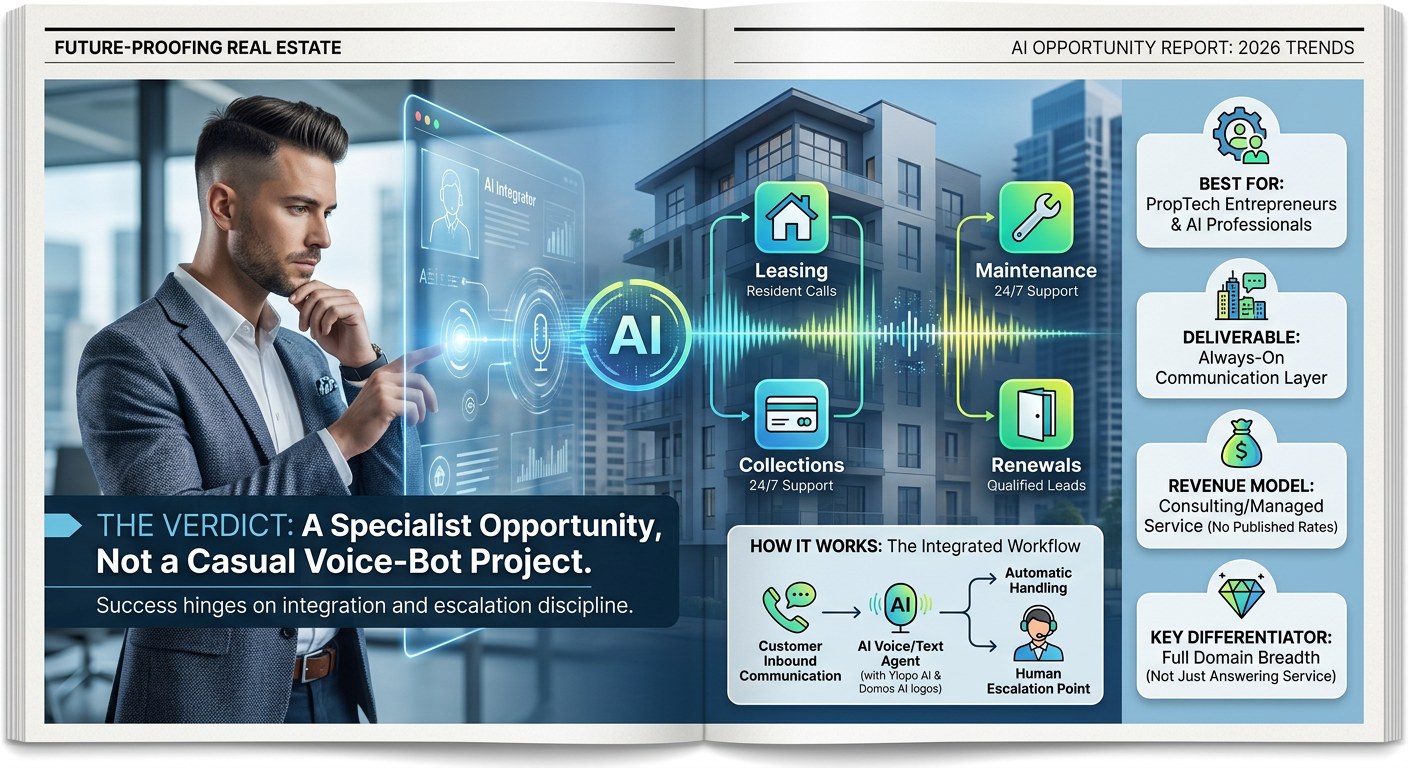
This business deploys always-on voice and text agents for property managers, residential operators, and leasing teams. The agents answer resident and prospect calls, qualify leads, and support leasing, maintenance, collections, and renewals. It gives a specialist operator a workflow-integration service to sell.
Why It's Trending
PropTech-specific voice and workflow agents are being marketed in 2026 as a 24/7 operational layer for repetitive resident and lead communications. The opportunity is a slow-burn pick with a recent category push, not proof that property teams have suddenly abandoned humans.
How It Works
- > Customer Problem: Leasing and resident teams lose time to repetitive calls and text interactions.
- > AI Solution: Deploy voice and text agents across leasing, maintenance, collections, and renewals.
- > Deliverable: An integrated communication layer with qualified leads and workflow handling.
- > Customer Acquisition: Sell to property managers and residential real-estate operators through a workflow-specific demonstration.
- > Revenue Model: Implementation or managed service; published rates are unavailable.
Best For
- > Entrepreneurs specialising in PropTech deployments
- > AI professionals integrating agents into real-estate workflows
- > Small businesses adding coverage without a large communications team
What Makes It Different
Its edge is domain breadth. It covers leasing, maintenance, collections, and renewals rather than just answering a phone. Multiple PropTech vendors are already active, so domain knowledge and integration quality must do the selling.
Getting Started
- > Skills: Real-estate workflow knowledge and deployment or integration ability.
- > AI Tools: Ylopo AI voice and text agents; Domos AI workforce for residential property management.
- > Initial Setup: Map the operator’s communication workflows, integrations, and human escalation points.
- > First Customer: A property manager or leasing team with repetitive inbound communications.
- > Delivery Model: Managed deployment and workflow integration.
Revenue Model
Consulting — no published rates.
Things to Consider
- > Competition: The market is early but growing, with multiple PropTech-specific vendors already active.
- > AI Dependency: Model and platform dependence can affect operational continuity.
- > Customer Acquisition: Real-estate operators need confidence that lead handling will not fail silently.
- > Scalability: Edge cases require human escalation and can complicate multi-client support.
Our Verdict
A specialist opportunity for AI professionals who understand property operations, not a casual voice-bot project. Success depends on integrations and escalation discipline before the first missed lead becomes a client anecdote.
8. QuickList AI Listing Assistant
What It Does
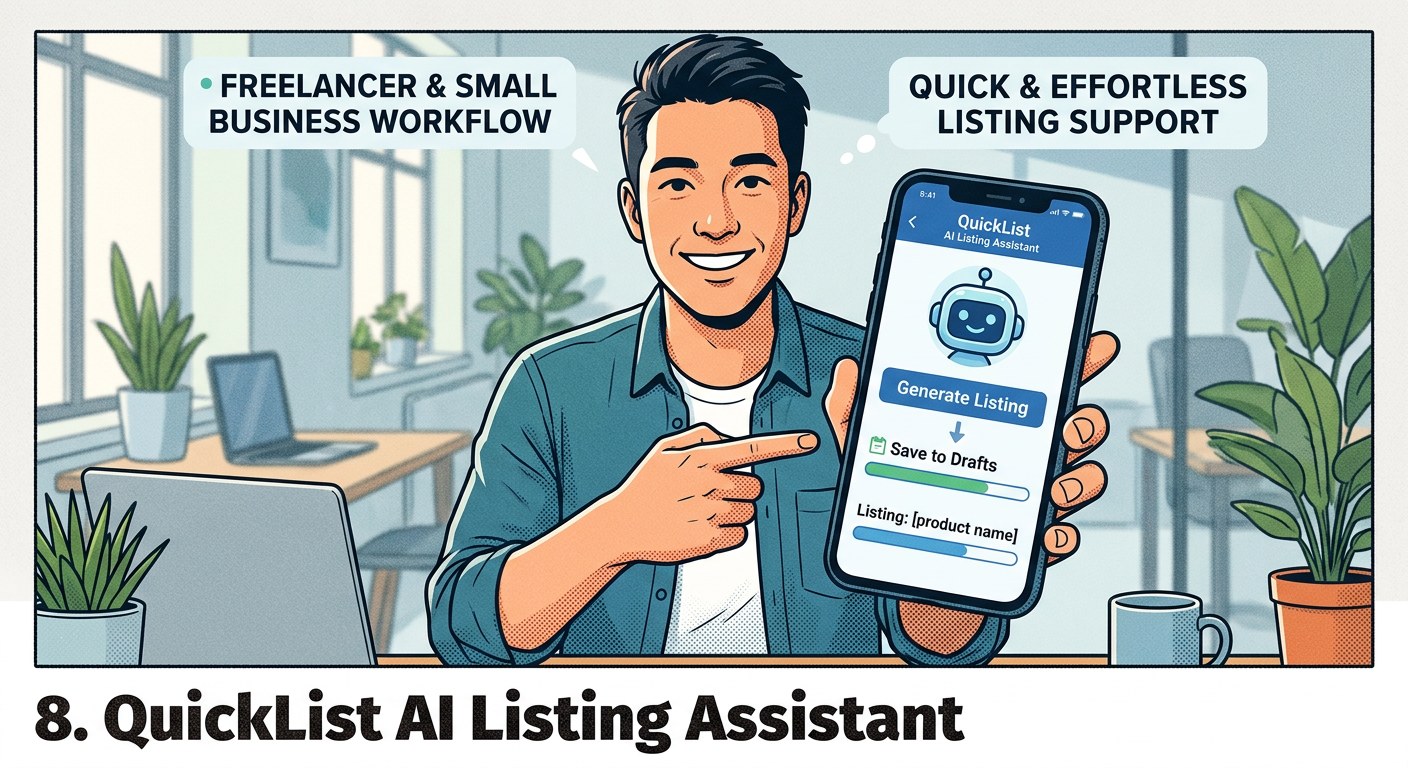
QuickList is a mobile subscription app for people who need listing-assistant workflows. A side-hustler can use it as the software layer for a listing-support service, helping users prepare listings more quickly. The app itself, however, remains the product most customers can purchase directly.
Why It's Trending
The app was listed in 2026 and ships as a paid subscription, with $9.99 monthly and $79.99 annual pricing. That is evidence of a current consumer offer, not a reliable measure of demand beyond the store listing.
How It Works
- > Customer Problem: Users need help preparing listings without writing every entry from scratch.
- > AI Solution: Use the mobile AI listing-assistant workflow.
- > Deliverable: Prepared listing assistance delivered through the app or an assisted service.
- > Customer Acquisition: Reach users who already need recurring listing support.
- > Revenue Model: Subscription software, with optional service wrapped around it.
Best For
- > Freelancers adding listing assistance to an existing service
- > Entrepreneurs testing a small subscription-backed workflow
- > Small businesses preparing recurring listings on mobile
What Makes It Different
Its advantage is convenience and a low consumer price. That makes it easy to test, but also easy to replace with a general AI tool or another app.
Getting Started
- > Skills: Basic listing workflow knowledge.
- > AI Tools: Mobile AI listing assistant software.
- > Initial Setup: Subscribe, test representative listings, and establish a checking routine.
- > First Customer: A user with recurring listing-assistant needs.
- > Delivery Model: Mobile self-serve subscription or assisted listing service.
Revenue Model
Product — published pricing is $9.99/month or $79.99/year.
Things to Consider
- > Competition: The store page alone does not establish category saturation.
- > Customer Acquisition: A side business must explain why a customer needs assistance rather than the app alone.
- > AI Dependency: General-purpose AI tools can substitute for the workflow.
- > Scalability: App-store dependence leaves distribution and pricing outside the operator’s control.
Our Verdict
Suitable for freelancers who already serve listing-heavy customers and need a cheap workflow layer. As a standalone business, it faces the less glamorous problem of being an app customers can simply download themselves.
This ranking leans toward specialist implementation and operational services over products needing distribution. The imbalance is telling. Published rates exist for only some entries, which is itself a useful piece of evidence.
The market is undoubtedly moving; the invoices, however, are not yet evenly distributed.