A developer can leave this month with a working agent, a deployed model, or a clearer grasp of the math underneath both. The strongest picks here are current, concrete, and honest about prerequisites. A few popular-looking options are catalogs or resource hubs rather than finishable courses, so they stay off the list.
These seven earn their places through projects, timely tooling, or unusually clear practical value.
1. Hugging Face Agents Course
What It Teaches
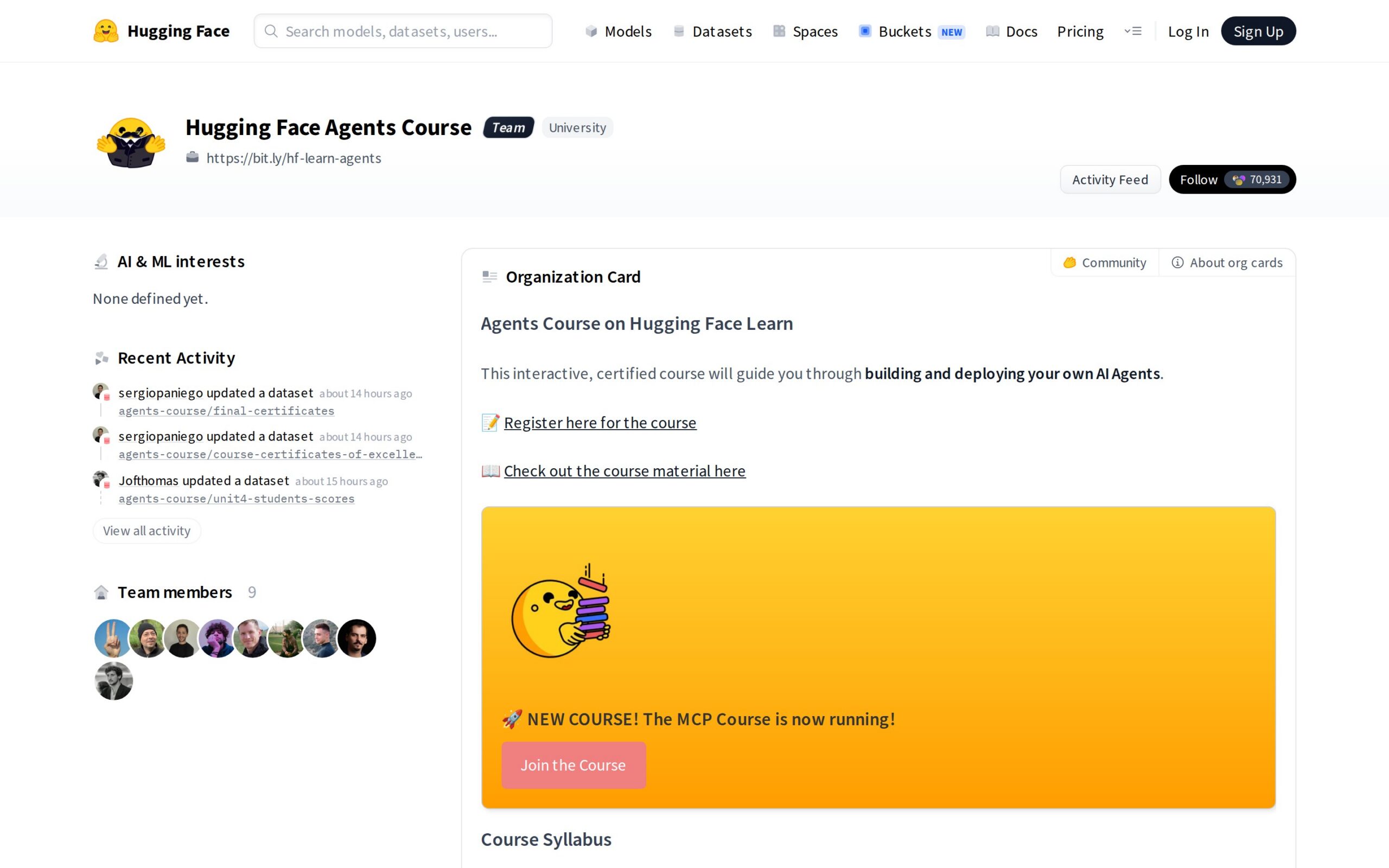
This interactive course shows learners how to understand, design, and build AI agents with current tools including smolagents, LlamaIndex, and LangGraph. The practical outcome is a set of working agents, ending with an agent aimed at the GAIA benchmark.
Why It's Trending
The course page was updated in September 2026 and explicitly says it uses the latest libraries and tools. Its combination of live sessions, challenges, and community sharing fits the current demand for agent-building skills better than a prompt-only class.
Key Learning Areas
- Agent foundations — explain how agent systems work and choose an architecture
- Agent frameworks — build agents with smolagents, LlamaIndex, and LangGraph
- Benchmark project — create and evaluate a final agent for GAIA
Best For
- Developers — building a first multi-tool agent
- AI professionals — comparing current agent frameworks
- Students — producing a portfolio project with an evaluation target
What Makes It Different
It combines written lessons with live sessions, quizzes, challenges, and a final benchmark-oriented build. That is more demanding and useful than a short agent overview, although the certificate is a course-completion badge rather than an external credential.
Duration & Format
Online and interactive, with live sessions — about 3–4 hours per week for each weekly chapter.
Pricing
Free — the completion certificate is included.
Things to Consider
- Prerequisites: requires Python programming, LLM prompting, and a Hugging Face account
- Time commitment: each chapter is designed as a one-week commitment at roughly 3–4 hours
- Practical component: assignments and challenges are central, but the work is specifically agent-focused rather than broad AI training
- Certification value: the certificate comes from completing the course, not an external accrediting body
- Course freshness: updated in September 2026 and explicitly tied to current libraries and tools
Our Verdict
A strong choice for developers and technically minded students who want a current agent portfolio piece, provided they already know Python and basic prompting. Learners seeking broad AI theory should choose elsewhere.
Course: https://huggingface.co/agents-course
2. Practical Deep Learning for Coders
What It Teaches
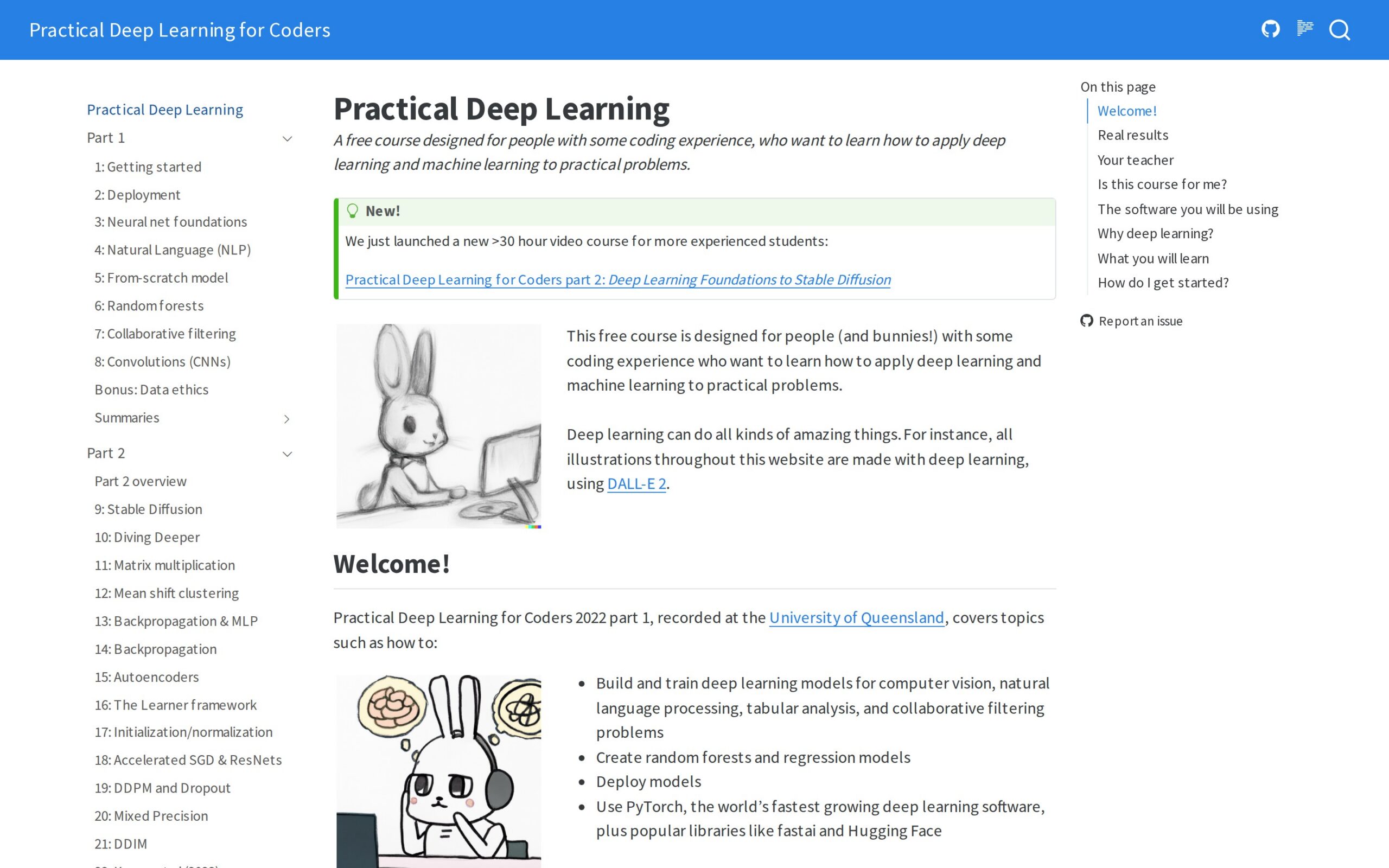
This hands-on course teaches learners to train and deploy models for computer vision, language, tabular data, recommendation, and diffusion tasks. They build models, turn them into web apps, and can continue into Part 2 to implement Stable Diffusion and related methods from scratch.
Why It's Trending
The main course page was updated in September 2026, while Part 2 was newly launched and described as having more than 30 hours of video content in August 2026. Its current coverage of PyTorch, Hugging Face, Stable Diffusion, DDPM, and DDIM keeps it relevant.
Key Learning Areas
- Model building — train practical models across several data types
- Deployment — turn trained models into usable web applications
- Diffusion systems — implement Stable Diffusion-related methods from scratch
Best For
- Developers — moving from notebooks to deployed models
- Students — learning through substantial practical builds
- AI professionals — refreshing hands-on deep-learning skills
What Makes It Different
The course is unusually implementation-first and includes deployment rather than stopping at model theory. It is free and current, but it is self-directed and offers no visible certificate or regular instructor feedback.
Duration & Format
Self-paced, online video course — about 13.5 hours for the nine-lesson main course, plus more than 30 hours for Part 2.
Pricing
Free — no certificate was visible on the course page.
Things to Consider
- Prerequisites: assumes some coding experience, although no special hardware or software is required
- Time commitment: Part 2 adds more than 30 hours beyond the main course
- Practical component: substantial model-building, app deployment, and diffusion implementation are required
- Certification value: the course page does not show a certificate
- Course freshness: the main page was updated in September 2026 and Part 2 in August 2026
Our Verdict
The best fit is a coding-capable learner who wants to build and deploy models rather than collect badges. It demands self-direction and meaningful time, so absolute beginners should not mistake its free price for low effort.
Course: https://course.fast.ai/
3. Claude Academy
What It Teaches
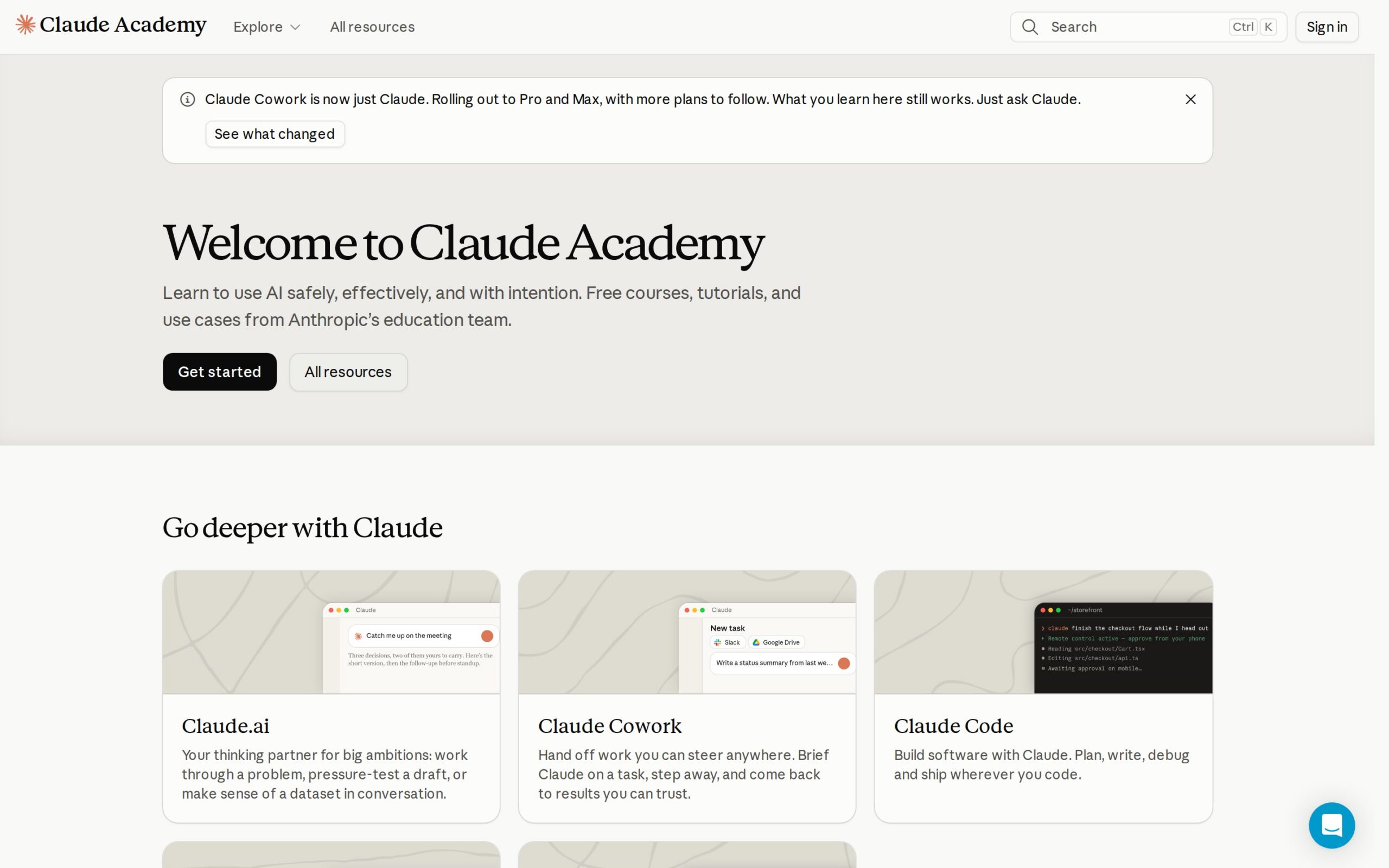
Claude Academy provides structured learning paths for using and building with Claude, from AI fluency and capability limits to builder-oriented work involving Claude and MCP. Learners can finish with practical workflow knowledge and completion badges, though the public builder material is not a full graded engineering course.
Why It's Trending
The catalog and learning pages were updated in September 2026, with builder and MCP content explicitly listed. That makes it a timely onboarding option for people trying to understand current Claude workflows without committing to a long technical program.
Key Learning Areas
- AI fluency — apply the 4D framework to everyday Claude work
- Capabilities and limits — recognize where Claude is useful and where it needs oversight
- Builder workflows — learn practical Claude development and MCP concepts
Best For
- Beginners — learning structured AI workflows
- Business leaders — understanding practical Claude collaboration
- Developers — getting oriented to Claude and MCP
- Students — earning completion badges while learning current tooling
What Makes It Different
The catalog is concise, organized by audience, and directly tied to Anthropic’s current product ecosystem. Compared with a general AI course, it offers faster product-specific onboarding; compared with a developer bootcamp, it lacks deep graded implementation.
Duration & Format
Online structured learning paths with video lessons and quizzes — roughly 2.5 to 4 hours for the visible courses.
Pricing
Free — completion badges are included; no formal external certificate is stated.
Things to Consider
- Prerequisites: no hard prerequisites are specified, but the appropriate level depends on the selected path
- Time commitment: visible courses range from about 2.5 to 4 hours
- Practical component: builder tracks support practical collaboration, but the public pages do not show a full graded capstone
- Certification value: badges document completion but are not presented as employer-recognized credentials
- Course freshness: the catalog and learning pages were updated in September 2026
Our Verdict
Claude Academy suits beginners, managers, and developers who need fast, product-specific fluency before deeper implementation. It should not be the only course for engineers seeking rigorous agent architecture or independent model-building practice.
Course: https://academy.claude.com/
4. Probability for Artificial Intelligence

What It Teaches
This six-week online course teaches the probability behind modern AI and neural-network fundamentals through hands-on projects. Learners finish with a portfolio of shareable apps, including an AI Word Detective project, rather than merely completing mathematical exercises.
Why It's Trending
The page was updated September 16, 2026, and the class is scheduled to start October 9, 2026. Its free, project-based approach and use of Code Agent tools give math-curious learners a current route into AI fundamentals.
Key Learning Areas
- Probability foundations — use the mathematical language behind AI
- Neural-network fundamentals — connect probability ideas to modern models
- App projects — create shareable portfolio work with free Code Agent tools
Best For
- Beginners — building mathematical confidence for AI
- Students — creating a public portfolio while learning fundamentals
- AI professionals — refreshing probability concepts behind neural systems
What Makes It Different
It pairs foundational math with visible application-building and a Stanford-hosted portfolio. That is more tangible than a conventional probability lecture, but it is still math-focused rather than a tools-first production course.
Duration & Format
Self-paced, online over six weeks — a few focused hours each week; the class is scheduled to start October 9, 2026.
Pricing
Free — the portfolio is the stated outcome rather than a traditional certificate.
Things to Consider
- Prerequisites: no formal experience is required, but learners need comfort with algebra
- Time commitment: six weeks at a few focused hours per week
- Practical component: includes hands-on projects and an AI Word Detective app
- Certification value: offers a public Stanford-hosted portfolio rather than a traditional certificate
- Course freshness: updated September 16, 2026, with the October 9 start date scheduled; current delivery status is not yet confirmed
Our Verdict
This is the right pick for beginners and students who want mathematical grounding plus a shareable artifact. It is a weaker fit for developers who need production APIs, deployment patterns, or advanced model engineering immediately.
Course: https://pai.stanford.edu/
5. Generative AI Explained

What It Teaches
This two-hour, no-coding course introduces generative AI concepts and common applications through NVIDIA’s AI Learning Essentials. Learners gain vocabulary and a basic conceptual map, but the cited page does not promise a model, app, or other finished artifact.
Why It's Trending
The page was updated in March 2026 and remains listed in NVIDIA’s active 2026 learning and certification paths. Its appeal is speed: someone can get a current-enough overview before deciding whether to invest in technical training.
Key Learning Areas
- Generative AI concepts — explain the basic ideas behind the field
- AI applications — identify common ways generative systems are used
- Tool orientation — develop a starting point for deeper NVIDIA learning paths
Best For
- Beginners — getting a fast conceptual overview
- Business leaders — understanding basic generative AI terminology
- Students — deciding whether deeper AI study fits their goals
What Makes It Different
It is shorter and more accessible than the technical courses on this list, requiring no coding. That accessibility is also the limitation: it offers orientation, not the hands-on capability a builder should expect.
Duration & Format
Self-paced, online — approximately 2 hours.
Pricing
Free — no certificate is stated on the cited page.
Things to Consider
- Prerequisites: no coding prerequisite is stated
- Time commitment: the complete course is approximately two hours
- Practical component: no build outcome or substantial project is stated
- Certification value: no certificate is stated on the cited page
- Course freshness: the cited page was updated in March 2026 and remains in NVIDIA’s 2026 learning catalog
Our Verdict
This is a reasonable first stop for beginners or business leaders who need shared vocabulary quickly. It should not be counted as finished technical training because the page promises no build, deployment exercise, or credential.
Course: https://www.nvidia.com/en-sg/learn/ai-learning-essentials/
6. OpenAI Academy: Agents and Workflows
What It Teaches
This online Academy course focuses on applying AI at work, with particular attention to agents, workflows, AI foundations, and practical agentic applications. A learner should come away able to think through workplace workflows, but the available course information does not identify a single final project.
Why It's Trending
OpenAI added Agents and Workflows as one of three new courses in June 2026. The launch places it directly in front of the current workplace demand for practical automation, although the public course information is thin on implementation detail.
Key Learning Areas
- AI foundations — build a working understanding of practical AI use
- Workflow design — identify workplace tasks suitable for AI support
- Agent applications — reason about agentic solutions for work
Best For
- Beginners — understanding workplace AI workflows
- Business leaders — mapping agent use to operational tasks
- Students — getting an official introduction to current agent concepts
What Makes It Different
Its advantage is direct alignment with OpenAI’s workplace-oriented AI framing and its June 2026 launch. The obvious drawback is that the available page does not expose enough syllabus detail to compare its technical depth with a builder-focused course.
Duration & Format
Online Academy course — duration and weekly hours are not stated on the available page.
Pricing
Pricing is not stated on the available page; certificate details are also not stated.
Things to Consider
- Prerequisites: the available course information does not clearly state them
- Time commitment: duration and weekly hours are not published in the available details
- Practical component: practical workflows and agentic applications are mentioned, but no final project is specified
- Certification value: certificate availability and value are not stated
- Course freshness: launched in June 2026 and therefore falls within the current year
Our Verdict
This course best suits business leaders and beginners who want an official introduction to agents at work, not developers shopping for a verified build curriculum. Learners should confirm access, hours, and assessment details before committing.
Course: https://openai.com/index/academy-courses-applying-ai-at-work/
7. Design and build integrated AI agent solutions in Copilot Studio
What It Teaches
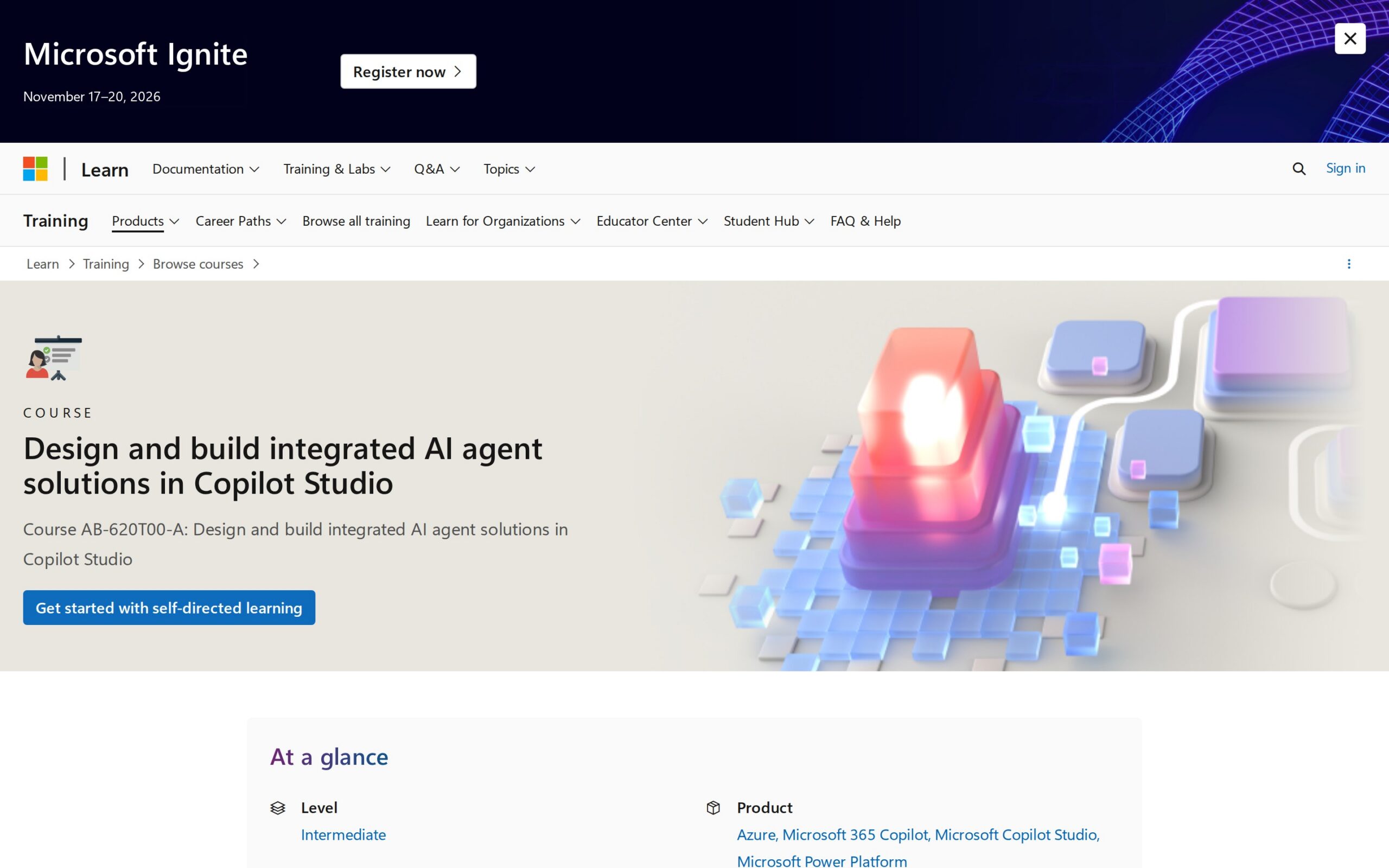
This three-day instructor-led course teaches practical solution builders to create production-oriented Copilot Studio agents and multi-agent systems. The work covers reasoning, workflow automation, external integrations, testing, deployment, monitoring, and lifecycle management, with integrated AI agent solutions as the build outcome.
Why It's Trending
Microsoft’s page says the course will be available on September 30, 2026, putting it directly in the October 2026 training conversation. Its emphasis on enterprise integration and operational monitoring reflects demand beyond toy chatbot demonstrations.
Key Learning Areas
- Agent architecture — design single-agent and multi-agent solutions
- Enterprise integration — connect agents to workflows and external systems
- Operations — test, deploy, monitor, and manage the application lifecycle
Best For
- Developers — building Copilot Studio agent solutions
- Business leaders — planning governed enterprise automation
- AI professionals — moving agents toward production operations
What Makes It Different
It is tightly scoped to production-ready enterprise agent architecture rather than general prompting. The tradeoff is material: it is not yet available on the page, and public pricing is absent, so buyers cannot fully evaluate it today.
Duration & Format
Instructor-led, online or in-person delivery options are described — three days; availability is scheduled for September 30, 2026.
Pricing
Paid — public price not listed; certificate pricing is not stated.
Things to Consider
- Prerequisites: advanced math is not listed; practical solution-building and enterprise workflow familiarity matter more
- Time commitment: three full days
- Practical component: includes building integrated agents plus testing, deployment, monitoring, and lifecycle work
- Certification value: an achievement code and related Microsoft certification path are mentioned, but it is not itself a standalone certificate
- Course freshness: scheduled for September 30, 2026; as of September 17, current hands-on availability is unconfirmed
Our Verdict
This is the most relevant upcoming option for enterprise solution builders who already work in Microsoft environments. It should wait on the shortlist until September 30 availability and pricing are confirmed.
Course: https://learn.microsoft.com/en-us/training/courses/ab-620t00
The pattern is straightforward: choose fast orientation only when orientation is the goal. For a tangible result, start with Hugging Face or fast.ai; for foundations, choose Stanford’s probability course. Microsoft’s Copilot Studio class is the one to revisit after its scheduled September 30 release.