Artificial Intelligence has taken many years to develop into an intelligent entity. However, it’s time to make connections. In 2026, the largest paradigm shift in artificial intelligence isn’t about the winner in the battle between models anymore. Instead, it’s about the capabilities of AI systems to achieve something in real software, processes, and infrastructure.
And it has its name – MCP – Model Context Protocol.
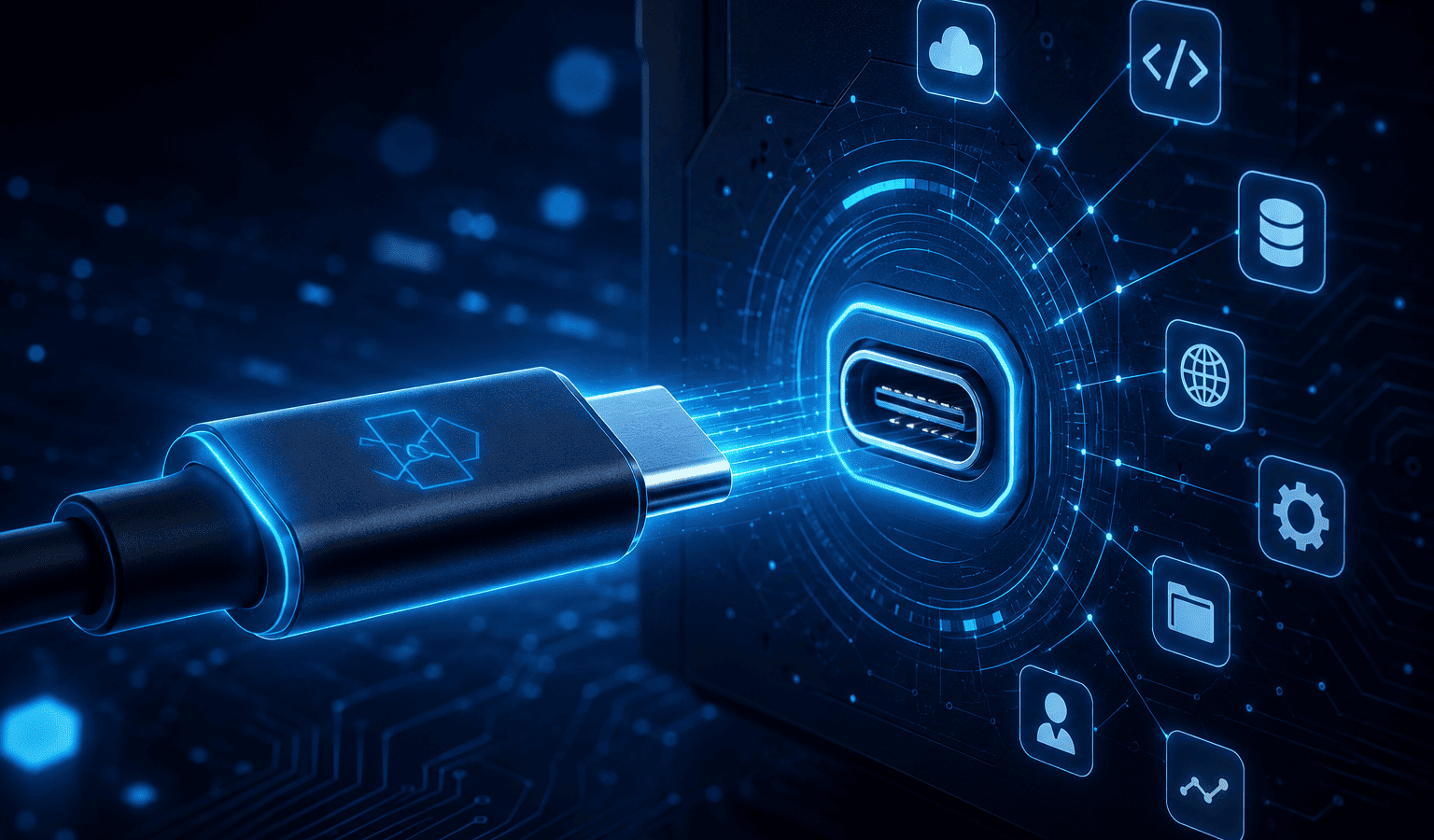
When APIs were used as the lingua franca of cloud software in the previous decade, now, MCP is gaining traction as the universal adapter interface for AI agents in the current decade. Developers call it the “USB-C of AI” because it enables standardising the process of communication of AI systems with other software, databases, IDEs, browsers, CRM, operating systems, and even hardware. The name is very suitable.
Before USB-C, everything was incompatible; each device had its own plug. Everything in each ecosystem was done differently. Nothing was in harmony with everything else. Before MCP, every AI agent was required to have customised connections with all other applications. It’s completely unfeasible in the era of autonomous AI systems.
The agent economy is becoming much faster connected than before, thanks to MCP. The Agentic AI Foundation received the donation of MCP governance from the Linux Foundation. MCP’s rapid growth can be seen with its adoption by many large organisations throughout the industry, including OpenAI, Microsoft, Google, AWS, and many other enterprise applications. In 2026, the anticipated installation of over $10,000,000 in MCP public servers will provide for development workflows, enterprise solutions, etc.
Although the MCP protocol is growing rapidly, that is not its primary goal — additional uses are being built on top of the protocol.
This article provides an analysis of what will occur with MCP in 2026 and concludes with reasons why MCP will be as significant for AI as HTTP is for the internet.
What Is MCP?
MCP is an open communication standard enabling integration between AI models (the ‘brain’), the MCP (the ‘port’), and third-party tools such as applications and devices (the ‘devices’) through a common, standardised communication protocol between the three entities.
When we build an AI model, we typically create ad-hoc connections from the model to external applications for communication. However, with the help of MCP (by providing a common communication protocol), we no longer need to create individual ‘ad-hoc’ connections for each application. Instead, we have a common, standardised way for the AI model to communicate with external applications.
Typically, when building an AI model or agent, the developer is faced with what is known as an ‘N x M’ integration challenge (where 50 AI models integrate with 500 tools). As a result, instead of creating up to 25,000 custom integrations, we can now create a single integration using the MCP standard (that is, a connection between the AI model and the tool using MCP).
With tool standardisation via the MCP standard, we can remove the integration complexity that we used to deal with during AI system development. Because of this speed of standardisation, we can move from a conversational AI to a much more future-oriented AI, where AI will take action and require tools in order to do so.
How MCP Became the “USB-C of AI”?
The analogy of USB-C took off due to how effectively it captures the key value proposition of a single connector for all things in one simple statement:
A single standard connector for everything.
According to David Soria Parra, one of the founders of MCP, the goal was to address the fragmented nature of integration of tooling in AI and provide a way for AI applications to access outside resources via a universal protocol. Timing was also ideal.
By early 2026, it was becoming clear that LLMs were not enough.
AI systems required:
– Memory
– Access to Tools
– File Systems
– Databases
– APIs
– Auth
– Context
– Coordination Between Multiple Agents
If there were no standard, then each platform would need to build its respective integration layer.
MCP arrived at exactly the right time. In addition, unlike most other AI standards, MCP garnered broad support from the ecosystem quickly and efficiently.
OpenAI added MCP to all products and development tools for ChatGPT. Google is utilising MCP integrations within Gemini and Vertex AI. Microsoft is implementing MCP inside Copilot, VS Code, and Azure AI.
MCP created a positive feedback loop. For each subsequent MCP server deployed, there was an increasing value created for the ecosystem. Additionally, for every newly built MCP-enabled client, there was an increase in demand for MCP-enabled servers.
The Top MCP Use Cases of 2026

1) AI Coding Agents That Actually Deliver Software
The development of software engineers was the standout use case for MCP in 2026. The evolution of coding tools has moved from allowing autocompletion to allowing for the creation of coding agents capable of:
Read repositories
Run tests
Query databases
Update tickets
Deploy applications
Managing CI/CD pipelines
Creating infrastructure code.
This was possible due to MCP consolidating access to all of the tools.
A coding agent is no longer required to have special integrations with GitHub, Docker, Kubernetes, Jira, Linear, PostgreSQL, AWS, and Slack individually. They are all accessible through MCP servers. Autonomous development flows have become much simpler.
The ecosystems of Cursor, Claude Code, Windsurf, Zed, and Copilot all adopted MCP-native flows by 2026.
Real Example
A developer can ask now:
“Analyse the payment bug impacting EU users, analyse logs, find the failing service, fix the problem, open the PR, and ping the engineering team about that.”
An MCP-powered agent can:
-
Connect to observability tools
-
Query logs
-
Analyse source code
-
Run tests
-
Fix the problem
-
Open PR
-
Update Jira ticket
-
Notify people via Slack
It’s not sci-fi anymore. It happens right now.
2. Enterprise AI Assistants With Operational Access
Early enterprise AI assistants were basically just fancy chatbots.
This all changed with MCP.In 2026, enterprise AI assistants more often than not function as operational co-pilots able to interact with enterprise software.
Some examples include: Salesforce, SAP, Zendesk, ServiceNow, Workday, Snowflake, Notion, Slack, and Confluence.
For instance, Zendesk’s MCP announcement in 2026 specifically talked about getting rid of one-offs and making AI interoperable with enterprise software.
This leads to an important development: AI assistants are becoming workflow execution systems from information retrieval systems.
Example of Workflow
A sales executive may request something like:
“Generate a renewal risk report for enterprise customers in APAC and book follow-up meetings.”
And the AI assistant would be able to:
-
Retrieve CRM data
-
Look at the history of tickets
-
Analyse the sentiment of the customers
-
Make summaries
-
Book meetings
-
Write follow-up emails
All through the MCP connections. It essentially becomes enterprise middleware for AI assistants.
3. Multi-Agent Systems & AI Teams
One of the biggest trends of 2026 will be that of multi-agent systems.
Where there used to be one big bot that did everything badly, there is now increasing reliance on specialised agents: Research bots, Coding bots, Law bot, Finance bots, Support bots, Security bots.
MCP makes it possible for those agents to communicate through common tool interfaces. That is where MCP really starts being revolutionary. The future of AI is not one big chatbot. The future of AI is an ecosystem of collaborative agents.
Example:
Product launch will include:
-
An agent researching competitors
-
An agent designing assets
-
An agent coding new landing pages
-
An agent designing campaigns
-
An agent predicting the expenses
MCP is the layer of interoperability that makes all this collaboration happen. Some scientists refer to MCP as an “operating system layer for agentic AI.”
4. AI-Accelerated Cybersecurity Operations
Among MCP’s enterprise applications, cybersecurity emerged as one of the fastest-growing applications.
Security operations centres produce massive amounts of disconnected data sources: SIEM alerts, threat intelligence, endpoint telemetry, network logs, IAM systems, and cloud audit logs.
Typically, analysts needed to pivot manually between different systems. With MCP, AI agents automate these processes.
Example
A security AI agent is capable of
-
Detecting malicious activities
-
Retrieving endpoint logs
-
Correlating network events
-
Querying threat feeds
-
Producing incident reports
-
Launching containment operations
All within a few seconds. This makes alert fatigue a thing of the past. Today, some teams leverage MCP-powered AI agents as “Tier 1 SOC analysts.”
Ironically, MCP created some security risks, which became a significant topic of debate in 2026 due to vulnerabilities discovered in a lot of MCP installations.
This shows that:
The more sophisticated the AI integration becomes, the more dangerous the compromised agents become.
5. AI Personal Operating Systems
One of the most intriguing uses of MCP technology is the development of AI personal operating systems.
The systems connect: Email, Calendar, Notes, Browser, History, Cloud Drives, Messaging apps, Finance apps, Smart Home systems.
The outcome is an AI overlay that understands your digital life in a holistic way. Rather than opening 15 apps, users now engage with a single intelligent orchestration system.
Example
Think about saying something like:
“Prepare me for tomorrow.”
MCP-based AI assistants could:
-
Brief you on meeting summaries
-
Analyze your emails
-
Scan relevant documents
-
Create task lists
-
Identify scheduling conflicts
-
Fetch traffic updates
-
Provide key news stories
This is the dawn of ambient AI computing. Not AI chat.AI orchestration.
6. Robotics and Physical Infrastructure
The MCP framework has been enhanced to also accommodate physical infrastructure and robots. More and more robots and physical structures are implementing interfaces that comply with the MCP framework.
As a result, physical systems equipped with the MCP framework allow AI agents to control these systems through standardised commands.
When used in logistics, this means:
-
AI agents can alter how inventory is managed
-
AI agents can invoke robotic workflows
-
AI agents can control warehouse infrastructure
-
AI agents can assess this data coming from sensors
-
AI agents can manage shipping processes
Overall, it is a means to connect digital intelligence with actual physical activity. Some analysts say that this may be a foundation for the automation of the industrial sector in the next decade.
7. Agents for AI Research.
MCP research processes move more quickly.
The functions of modern AI research agents include: Searching for papers, consulting databases, running programs, creating visualisations, referencing previous work, and producing literature reviews. Rather than using an AI as a search engine, researchers are increasingly turning to AI as a research partner.
Example:
A bioengineer could say to an AI:
“Show me the most promising protein engineering methods to improve enzyme stability published after Jan. 2025.”
The AI could:
– Evaluate databases
– Look at the literature
– Identify trends
– Create summaries
– Suggest experiments
This would save the researcher several weeks of work by eliminating the 4-6 week research cycle.
Why are enterprises attracted to MCP?

Enterprises appreciate and continue to appreciate MCP for three reasons.
1. Reduced costs associated with integration
Traditional AI integrations are very expensive and unreliable.
MCP has attempted to standardise communication protocols, which will greatly reduce the cost of engineering required.
2. Model agnostic (independent of vendor).
Enterprises don’t want to reinvent integrations when models change.
MCP has designed their method of working with models from Claude, ChatGPT, Gemini, open-source, or Enterprise, to be cloud-agnostic or portable among different vendors. The idea of being locked into a vendor will no longer exist.
3. Faster implementation of AI solutions
MCP will develop AI more quickly than many enterprises can. By utilising the existing integration provided by MCP, an enterprise can deploy its AI solution without waiting months for integration into its own systems. Time to market is usually more important than anything else in a competitive environment.
Problems Ignored by All
MCP’s flaws are many and noisy.
MCP’s complaints are growing in number these days.
Vulnerability Types
There are many types of security vulnerabilities found in MCP systems that have been disclosed by security experts, e.g., command/command injection vulnerabilities, proof of concept (POC) vulnerability tests, malicious exploitation, and supply chain attacks.
Claims of lagging espouse that the developing side of the development of the system takes precedence over the security aspect of the development; however, this imbalance has always existed, decaying product integrity, resulting in product failure.
First, the internet; next, cloud computing; now AI agents.
Token Overheads
Another major criticism of MCP is that token overheads are large. Tokens for tools on MCP servers are significantly large and thus consume the context windows very quickly. A few developers believe that some tools could be developed faster via a direct API or CLI interface and that this would be cheaper than developing a tool for an indirect interface.
There have been many discussions regarding the following subjects: efficiency of tools, latency of tools, cost of tokens, overload of tools…
The community is currently conducting trials with the following: deferred loading of tools, dynamic selection of tools, tool registries, and compressed schemas- some of these potential solutions may be the future of MC.
Tool Chaos
The emerging problem is one of ecosystem fragmentation. There are now thousands of MCP servers. These range in quality widely. Some are production-level. Others are insecure experiments.
This parallels the early browser extension ecosystem and early mobile app ecosystems. Standardisation addressed interoperability. But it didn’t address trust.
Expert Insight: The Importance of MCP Goes Far Beyond General Understanding
The greatest misunderstanding regarding MCP is that it is “nothing but a developer protocol.”Nothing could be further from the truth.MCP is a paradigm shift in the architecture of software.
Traditionally:
People have interacted through user interfaces. Software runs on logic
But now…
Artificial intelligence agents will use software more and more. Everything changes. Applications must now be…
-
Intelligible by artificial intelligence
-
Usable by artificial intelligence
-
Compatible with artificial intelligence
MCP serves as the connecting factor for this reality. In many ways, it is akin to the early emergence of web standards. Initially, it was only about the technicalities of HTML. Then it became the base for the whole economy of the internet. So may MCP become for agentic computing.
MCP Beyond 2026?
Several clear trends are already taking shape.
1. MCP Apps Ecosystem
With MCP Apps, there is a standardisation of UI delivery of AI agents, enabling dynamic rendering of interactive dashboards/interfaces. This could mean that in the future, AI systems will deliver not only text-based outputs but also interactive applications on request.
2. AI Marketplaces
We witness the emergence of MCP tools marketplaces where software developers can share AI functionality. This can evolve into an “app store” for AI agents.
3. Secure MCP Variants
Security-oriented variants such as SMCP have already started to emerge.Expect governance layers to become a must-have feature for enterprises.
4. Autonomous Companies
The most radical trend would be fully autonomous workflows of organisations.
Imagine…
-
AI-driven finance departments
-
AI-driven operations departments
-
AI customer service organizations
-
AI procurement systems
-
All interacting via compatible protocols, such as MCP.
This scenario looks rather futuristic. Yet, parts of it have already been implemented.
Final Thoughts
So, why is MCP labelled the “USB-C of AI”? It’s certainly not for its showy novelty – it is for addressing a major structural issue in artificial intelligence: interoperability.
AI has been operating in isolation for years. Sure, it could write texts, answer questions, and perform some automated functions. But when it comes to the actual engagement in the real digital world, every integration was unique and had to be engineered separately, each operation was segmented, and each company faced the same challenge of scalability. But with the emergence of MCP, all this became history, as it provided a universal connection language for AI systems and external software.
What distinguishes MCP from others is its power to make AI more operational than conversational. It means that AI is no longer just engaged in conversations but can work with databases, coordinate various software components, manage workflows, interact with enterprises, and even control physical infrastructure. So, it is time to let AI become a part of operations, rather than an assistant.
The emergence of agentic AI in 2026 has increased the importance of this protocol tenfold. Autonomous coding agents, enterprise copilots, research assistants, cyber defence systems, and multi-agent AI systems – all require one key capability: the ability to interface and collaborate between applications seamlessly. That is precisely what MCP does.
This is why the importance of MCP goes way beyond the programming sphere – it is the beginning of a new epoch in software engineering when applications are built not only for humans but for agents that are capable of independent reasoning, acting and cooperation.
The firms that choose to integrate MCP now are not just making their AI processes more efficient – they are preparing for the time when AI will become an integral part of the operations. For many reasons, the AI competition of 2026 is no longer about creating smart models anymore. It is about creating better links. And MCP is quickly becoming the standard link of the AI era.