Google, Samsung initiative with ‘Circle to Search’ features available on over 580+ million phones, and aspiring startups are revitalizing Vibe Shopping. E-commerce is becoming even more exciting with frictionless AI merchandising. Shopify extends its capabilities with agentic e-commerce. The article will take you on an in-depth exploration of the latest overhauls in e-commerce with AI.
Vibe Coding gave the tech world a new vision for app creation. It enabled ambitious minds to bring their thoughts into reality while expressing themselves in plain language to AI and seeing technical work done by machine. Vibe Shopping targets a wider audience with the intention to make their shopping experience fun, focused, and customized. It is redefining consumer products’ discoverability, reviews, and brand loyalty. Sophistication of AI and its popularization is turning e-commerce into an immersive pursuit.
An Advantage For Vibe Shopping Hustles: Universal Appeal of E-commerce

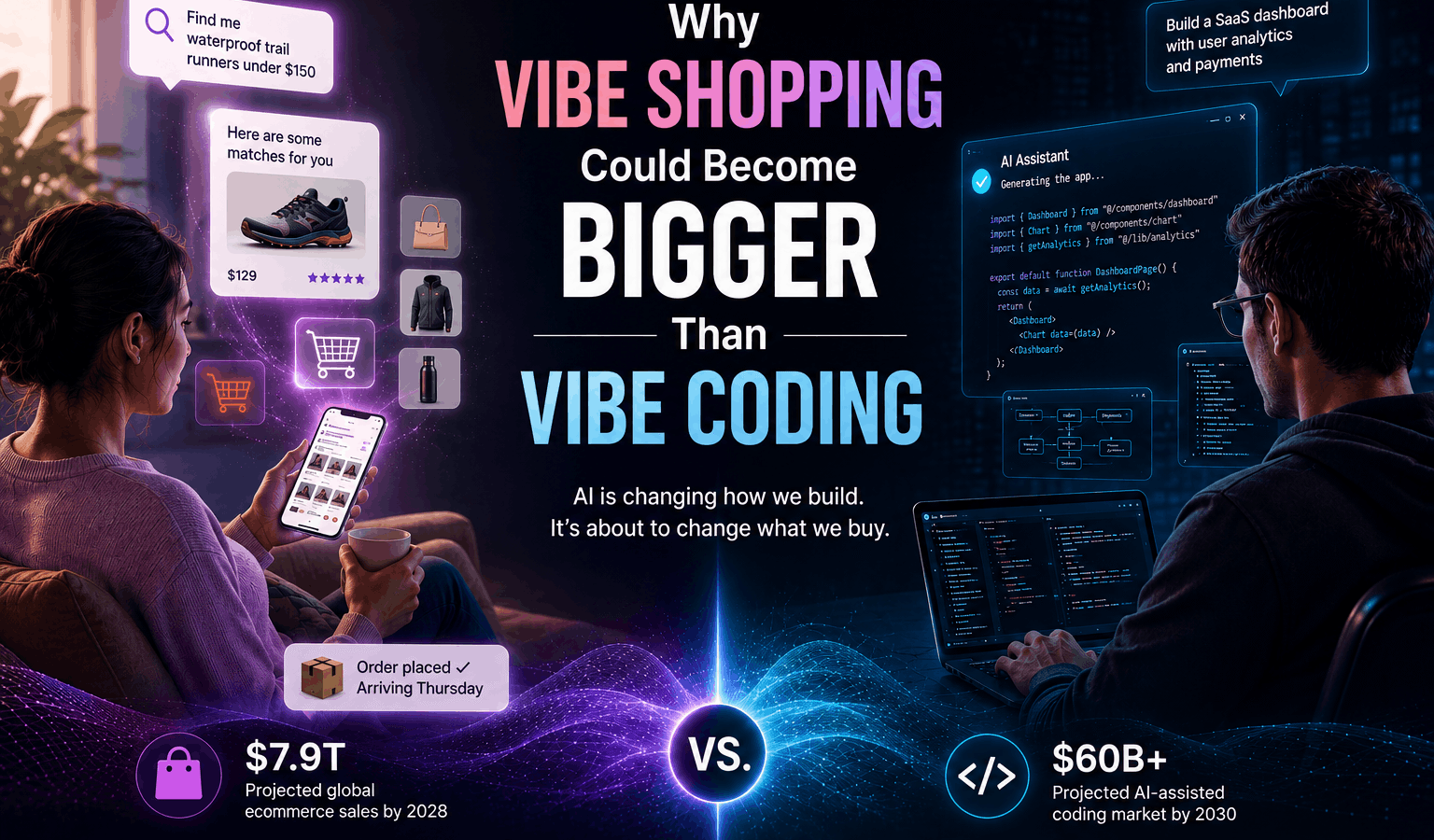
Vibe Coding is impressive as it made use of trending AI prompting to replace syntax, helping end users to build faster, attractive MVPs and prototypes for their business pitches; however, the audience of the market is still relatively limited at this time. Despite all the attraction it gets from startups, developers, marketers, and various non-technical creators quickly learning how to Vibe Code and potentially using it in their production, it is generally tied to software development. Vibe Shopping, on the other hand, appeals virtually to every consumer, every day, and across a wide variety of categories of products such as fashion, beauty, home decor, electronics, travel, and collectibles. Vibe Shopping is creating a structural reset of how consumer demand is expressed and fulfilled across the entire e-commerce economy.
While making purchases online comes with challenges, the biggest one isn’t how customers pay but rather how they discover products. As a result of having so many product options available to them, shoppers can often feel confused or go through a stressful shopping experience when trying to select items as they search across pages of options. Vibe Shopping offers a more personalized way for customers to find out the best products to buy by prioritizing consumer intent and providing a contextual experience.
Vibe Shopping is set up in such a way to eliminate distractions for consumers and help them make a more informed decision about whether or not they should purchase a particular product. It eliminates much of the noise consumers experience when shopping and provides clarity of purpose for purchases. Shopping is an emotional and aesthetically driven human experience, and it is also tied to one’s lifestyle. The ability for an AI to identify your “vibe” gives them a stronger psychological bond with the user than an AI model programmed to write a Python script for an app.
Google’s AI and Protocols Making The Prime Impact

Google’s latest endeavors into commerce are demonstrating the sheer advancements in the tech space. With their collaboration with Samsung, Google launched the new conversational shopping experience feature, “Circle in Search,” that enables users to activate it by holding the home button on their Android phone and proceed by circling or scribing the upshot they want to explore; the phone will scan the chosen image without switching apps and present multiple distinct products that match their desired product. The second feature is powered by Google AI Search; ask Gemini what you have in mind, and it will instantly fabricate a personalized list for you, having rich visuals and product details like price, reviews, and website. It gets better when you describe your style, mood, and occasion to narrow the search to what suits your purpose.
Earlier this year at the National Retail Federation event in New York, Google announced the Universal Commerce Protocol (UCP). Google states its goal is to help retailers get discovered and pragmatize agentic e-commerce transactions for merchants with UCP, an open standard that aims to provide an interoperable means of connecting AI Agents and Merchant Systems throughout the entire shopping journey – from the time of the consumer discovering a product, purchasing an order, to offering post-purchase support to retailers.
Before UCP, each AI Platform had to establish its proprietary connection to each retailer’s checkout system. This resulted in fragmentation, limiting agentic commerce environments’ ability to be fluid in nature. UCP has also been designed for vendor agnostic and is compatible with other industry protocol standards such as Agent2Agent, Agent Payments Protocol, and the Model Context Protocol. The objective of UCP is to allow shoppers to find and purchase products using AI assistants, such as Gemini, ChatGPT, and Microsoft Copilot, while ensuring the closing merchants remain the recognized sellers of record.
Shopify Agentic Storefront Reducing Barriers to Entry To E-commerce

On March 24, 2026, Shopify added support for agentic merchandising e-commerce where eligible merchants have the ability to share product catalog data with AI shopping platforms using Shopify-owned AI tools. Instead of individual integrations to AI channels, they can simply specify the catalog distribution on their Shopify account, making their products searchable on ChatGPT, Microsoft Copilot, and Google AI Mode as per the requirements of the platform and product eligibility that is visible to merchants.
The way this happens is via the Shopify Catalog and Universal Cart. Shopify Catalog is a structured, intricate data container with live product information such as titles, descriptions, image(s), localized prices, and inventory for each product in real time. This is sent to each AI platform connected through Shopify, always on private APIs. In here, products of the same SKU are clustered into a Universal Product ID, making fewer duplicates and displaying more relevant results to the user. When an AI agent produces a result from a consumer request, it pulls from Shopify Catalog rather than scraping a storefront page, so the product data the AI agent displays is accurate, up-to-date, and complete information in a pre-determined format rather than agents web crawling the information from multiple websites. Upon Shopify’s agentic AI completing the consumer search request, the consumer checks out varies based upon which model is used for the search; on MS Copilot and Google AI Mode the checkout occurs through an embedded checkout in the conversation powered by UCP, while the consumer using ChatGPT is redirected to the merchant’s storefront via either their mobile application’s browser or a new tab in their desktop browser and purchase through Shopify’s storefront with no hidden transaction fees other than standard processing rates.
Shopify’s Universal Cart can hold products from multiple stores, allowing consumers to purchase all selected items in one go, and when the user is ready to purchase items, the Checkout Kit loads the merchant’s checkout, combining flawless payment processing and customization with agentic marketing.
Since January 2025, referral sessions from AI platforms including ChatGPT, Perplexity, Gemini, Copilot, Claude, and Grok grew more than eight times year-over-year on Shopify storefronts. In its Q1 2026 commerce analysis, Shopify found that shoppers who arrived via AI platforms convert at nearly twice the rate of those who arrived via organic search when they land on product detail pages. This conversion advantage exists across 23 of 25 merchant categories examined. According to Shopify, this difference is due to what it calls journey compression: AI searches combine the discovery and consideration phases of shopping into one discussion, meaning by the time a shopper arrives at the product page, they have already done their research and shown a strong intent to buy.
Some of the initial brands confirmed for Microsoft Copilot Checkout are Keen, Pura Vida, and Kyte Baby. Gymshark, Everlane, and Monos are among brands that have now confirmed they will be selling directly through Google AI Mode and within the Gemini app. On May 5, Shopify’s Q1 2026 earnings report revealed the company’s merchants sold $100.7 billion in gross merchandise volume for the quarter, up 35% year over year and the largest quarter in Shopify’s history. CFO Jeff Hoffmeister attributed the GMV number to “the platform compounding” and added, “Shopify has entered the AI era with a clear edge: strong, durable growth and two decades of commerce intelligence. That puts us in a category of one.”
Niche Platforms Where Vibe Shopping Is Already Native
The most innovative of the Vibe Shopping on the scene right now. Backed by Google and powered by Gemini and Google’s Imagen 4, Glance pushes AI-generated shoppable looks directly on your Android lock screen. The user is asked to upload a selfie once; Glance builds a generative avatar and presents personalized looks directly to the phone’s idle screen as a notification with no app launch and no search necessary. The app can be a stress reliever and creativity booster for some users. It debuted with a network of 400+ e-commerce partners and launched on Samsung phones in the U.S.
The Tel Aviv, Israel-origin platform is a startup giving fashion merchants access to AI-powered virtual try-on and sizing. Its computer vision model simulates fabric texture, color, styling, and replicates on a user’s uploaded human image within seconds, increasing purchase confidence and reducing returns. For mid-size fashion merchants without the engineering resources of big enterprise brands, Pele AI provides a low-barrier path to consumer-grade try-on tech for mid-sized retailers, with ROI claims of an increase in 45.7% conversion rate and 3x larger cart size.
The niche women’s clothing merchant brand founded by Phoebe Gates and Sophia Kianni and launched in April 2025 that serves as a personal shopping assistant, monitoring pricing for over 40,000 e-commerce and secondhand retailers in real-time. A “Should I Buy This?” browser extension detects if a specific product’s price is above, at, or below its average price point and recommends alternatives, including second-hand versions if available at a better cost. Phia raised $8M in seed funding, already built a user base of 500K within five months in the market, and owns the second largest used-fashion index in the US at over 300M items. Phia will leverage its proprietary LLM (which is trained on user transaction data) to accelerate progress towards a completely autonomous personal shopper.
Why Merchandising Agents Are Becoming the New Back Office
Merchandising agents are becoming the new back office. The consumer-facing discovery of Vibe Shopping is only one part of the equation. On the merchant side, we are starting to see a new class of merchandising agents powered by AI that are automating many of the functions that entire teams have traditionally performed manually. These agents are managing product listings, adjusting prices and responding to real-time competitive signals, enriching catalog data to ensure optimal performance with answer engines, and answering customer questions about products on their pages in the brand’s own voice and tone.
Merchants having a “business agent” embedded on a product page, which can interact with a browsing customer as if it were a highly trained sales associate who understands every product in the catalog, is a fundamental change in e-commerce. Instead of operating within the confines of a traditional chatbot that follows a decision tree, an AI-powered merchandising agent uses all available data in a brand’s catalog, the tone and style of the brand, and information about a particular customer to respond to customer inquiries in a highly nuanced manner, respond to objections, provide relevant alternatives, and help customers make purchase decisions in the same way that a highly-skilled associate could do in an in-store environment. Adobe reported that AI-driven traffic to US retail sites increased 393% YoY in Q1 2026. The AI-referred traffic reached 269% YoY growth in March 2026, projecting a similar growth as seen in the 2025 holiday season. The analysis from Adobe measured over one trillion visits to partnered retail and other client websites.
Here’s How Agentic Merchandising Business Layers Work:
-
Catalog Intelligence
The agent integrates with descriptive product data, including specifications, available stock levels, pricing information, brand guidelines, and historical consumer interactions, to gain a comprehensive understanding of the merchant’s business and catalog.
-
Answer Engine Optimization
It structures and optimizes product content for AI-powered search and other shopping solutions to parse, rank, and suggest items across different conversation channels and touchpoints accurately.
-
AI-Powered Product Assistance
Product page agents provide customer service through natural language conversation with visitors while owning the brand voice; they assist users with size and fit queries, return policies, offer alternative product recommendations, clarity on available stock, and may also initiate checkout without the customer navigating away from the page.
-
First-Party Data Flywheel
Every customer interaction feeds back into a proprietary data asset the brand owns, signaling to enhance user-level personalization, promote brand loyalty, and improve recommendations and seasonal campaign marketing while eliminating dependence on third-party data or projectiles.
Conclusion
These developments show that Vibe Shopping is no longer a vague idea floating across retail. Collectively, advances in consumer and merchant shopping experiences have made the journey more seamless, interactive, and AI-driven. Agentic e-commerce lowers the barriers to building digital retail businesses and improves the consumer journey, making discovery, comparison, confirmation, and transactions less tedious and less technically demanding. The experience is only set to improve with further human innovation and creativity.
A shopper might discover a product visually on a Samsung device, use Google AI Mode to explore their interest, and complete a multi-platform purchase through a UCP-enabled checkout in a single transaction. Meanwhile, another shopper may find inspiration through Glance AI without actively searching, while Phia can help determine whether a product is priced fairly enough to buy or whether a better alternative is available. B2B Vibe Shopping companies such as Pele AI are also expanding support for niche e-commerce businesses beyond the capabilities offered by major platforms such as Shopify or Amazon.
While Vibe Coding changes how we build the digital world, Vibe Shopping reshapes how e-commerce operates and how businesses interact to improve consumer experiences. Because consumption is now omnipresent, emotional, and deeply tied to identity and lifestyle, the cultural reach and economic force of Vibe Shopping could eventually outpace the developer-centered world of Vibe Coding.
**Sources: 1. Shopify Agentic Storefronts – Introducing Shopify Agentic Storefronts: Sell your products everywhere AI conversations happen
-
2. Google – Circle to Search