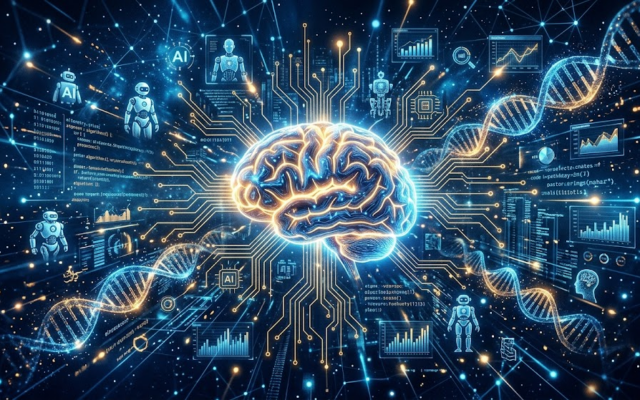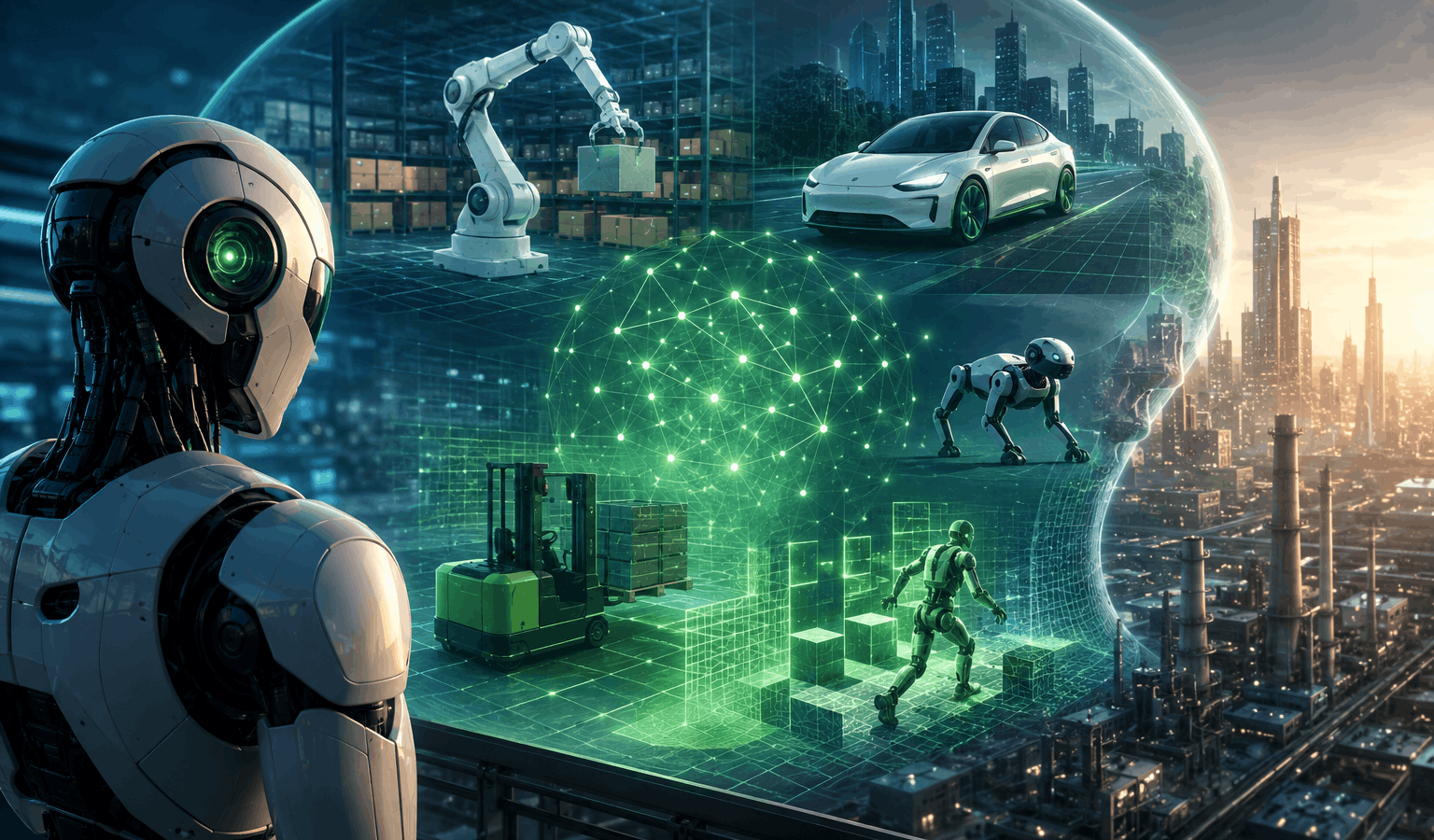
For its part, artificial intelligence had spent the previous ten years learning about the digital world. Large language models can craft essays, produce software code, summarise scientific studies, and converse at increasingly higher levels of sophistication. Meanwhile, image generators can produce hyper-realistic images from simple instructions, while AI systems are able to crunch massive amounts of data much faster than any human team.
But despite all of these remarkable achievements, most AI still lives entirely in a virtual world – it is able to describe how different objects interact with one another and understand the laws of physics, but may not intuitively comprehend how the world around us really works.
However, this weakness might soon become a stumbling block on the road towards a new wave of technological advancements. Self-driving cars must be able to foresee how pedestrians and other vehicles around them will behave. Robotic assistants will need an understanding of gravity, movement, mechanics, and spatial relations before they start operating side-by-side with humans.
Industrial automation will require advanced predictive abilities when working in ever-changing environments. And according to NVIDIA, a key element in making the future happen will be creating AI systems capable of reasoning about the
Understanding Physical AI Reasoning
Before discussing the significance of Cosmos 3, it is crucial to define the concept of physical AI reasoning. Traditional AI algorithms are highly effective when it comes to identifying patterns in the provided text or imagery, but physical AI reasoning implies an understanding of the interaction of objects and environmental factors.
What Is Physical Reasoning and Why Is It Important?
Humans develop their intuitive physical intelligence from childhood. They know that things always drop on the ground once they get released, that water goes downward, and that moving an object that weighs a ton demands more effort than moving one that weighs a pound. Thanks to our innate physical intelligence, we can make predictions about events even before they happen.
For machines, it is a completely different story since most of them work based on statistical data analysis. As a result, AI might find it challenging to deal with any situation that it has never faced before while being trained.
Physical Intelligence Capabilities
Physical AI reasoning implies the following skills:
1. Understanding the connection between cause and effect
2. Predicting movements and trajectories of objects
3. Understanding spatial relations
4. Estimating the amount of force and
Why Does Contemporary Artificial Intelligence Have Problems With Physical Understanding?
Pattern Recognition ≠ Understanding
Contemporary artificial intelligence technologies can recognise patterns quite successfully. But recognising a pattern does not mean understanding how the world works.
If AI is trained on a large number of video clips showing falling objects, it will understand that the dropped object typically falls downwards. Nevertheless, the AI recognises the pattern rather than understands the phenomenon of gravity. In other words, when it sees some unusual scenarios, it may predict the behaviour that breaks the laws of physics.
Real-Life Experiments Are Too Expensive
The difficulty with creating physical AI comes from the lack of scalable sources of data. In contrast, text-based AI can be trained on billions of documents accessible online. The data needed for physical AI should be obtained via sensors, cameras, robots, and other means of interaction with the world around.
It is costly to accumulate such information. Also, each new experiment produces data for only one type of environment, which is hardly generalisable enough.
Safety Issues Limit Real-World Learning
Humans learn from experiments, and mistakes are an essential part of their learning process. But allowing a factory machine to do experiments may damage expensive
Physical AI Vision at NVIDIA
NVIDIA does not limit itself to merely producing AI processors that operate faster than those of its competitors. During the last few years, the company has been working on an ecosystem that would allow the development of intelligent devices that could work within real-world conditions.
Foundations of Intelligent Machines
Initially, the GPUs from NVIDIA provided the possibility of parallel computation needed for implementing AI. Later, when the models got more sophisticated and complicated, the company decided to expand the scope of its business.
The new strategy made it possible for NVIDIA to solve the problem of connecting artificial intelligence to physical reality.
Omniverse in NVIDIA’s Ecosystem
An important part of NVIDIA’s long-term vision involves the use of its platform, known as Omniverse, which enables businesses to create digital twins that will be precise copies of their physical counterparts.
In other words, using NVIDIA’s Omniverse, one can create digital simulations of factories, warehouses, traffic networks, cities, and all kinds of manufacturing processes. This way, there will be a safe environment for AI learning and testing.
Cosmos 3 enhances this technology with new opportunities for physical reasoning.
What is NVIDIA Cosmos 3?

On a basic level, NVIDIA Cosmos 3 will aid AI algorithms in achieving a better understanding of the mechanics and processes of the physical world.
While earlier solutions helped the computer recognise objects and respond to user commands, NVIDIA Cosmos 3 aims at teaching the machine to make predictions about future events and understand the results of its actions.
The Next Step in Development – Creating World Models
One of the main features of the upcoming release by NVIDIA is the development of new types of world models.
A world model is an artificial simulation of reality which allows an algorithm to imagine different scenarios, test them in one’s mind, and evaluate their consequences. Unlike the current approach, where the machine reacts immediately after getting a certain input, world modelling requires a different approach, closer to the one humans use daily. For example, when crossing a street, one can predict and assess the movement of nearby vehicles before making any steps.
Learning by Simulating
With its latest invention, NVIDIA will allow machines to learn in a much more efficient manner. Generating simulated environments means providing machines with much more experience than they would normally obtain
The Potential Impact of Cosmos 3 in Robotics
Robotics will greatly benefit from innovations in physical reasoning in AI.
Better Decision Making
At present, many robots operate under predetermined rules and narrow-minded models. As a result, their behaviour suffers when they encounter unfamiliar conditions.
With world-model reasoning, robots will be able to make judgments and take actions based on several options. This will minimise mistakes and improve the robots’ performance.
Faster Learning
Robots have to be extensively trained through real-life experiments to function properly.
However, robots with physical reasoning enabled via Cosmos 3 will be able to learn skills at an accelerated pace. For instance, in just a few days or weeks of practice, robots may gain years of experience.
Greater Adaptability
Manufacturing facilities, storage facilities, and even houses undergo regular changes.
However, with robotic systems endowed with advanced physical reasoning, adapting to any changes is no longer an issue.
Opportunity within Autonomous Driving
Autonomous driving is still one of the most challenging uses of AI.
Vehicles have to constantly observe and analyse the rapidly changing environment and make real-time decisions.
Moving Beyond Simple Object Recognition
Current autonomous technologies have become very proficient at recognising other cars, pedestrians, road signs, and lines on the road. However, in order to drive autonomously, vehicles need to predict what each object will be doing.
Cosmos 3 could improve this prediction capability by providing more insight into objects’ actions.
Preparing for Uncommon Scenarios
Some of the greatest difficulties in autonomous driving come from the fact that potentially harmful edge scenarios rarely occur.
These scenarios include:
Sudden movements of pedestrians
Unpredictable moves of other vehicles
Extreme weather conditions
Debris on roads
Unusual traffic circumstances
With simulation environments built upon world modelling technology, an AI-powered system can encounter such scenarios thousands of times in a training environment.
Industrial Automation and Smart Manufacturing

Today’s manufacturing plants are becoming smarter; however, in a lot of cases, there is still an extensive need for human input.
Smart Digital Twins
A Cosmos 3 system might improve digital twins through increased ability to predict the functioning of a manufacturing plant.
The artificial intelligence systems would be capable of predicting future manufacturing challenges and optimising the workflow process.
Predictive Maintenance
Malfunctions of equipment cause manufacturers’ financial losses worth millions of dollars.
By gaining deeper knowledge of physical processes, AI systems would be able to predict malfunctions before they occur. The Rise of Embodied AI
Embodied AI refers to intelligent systems that interact directly with the physical world.
Examples include:
-
Humanoid robots
-
Service robots
-
Warehouse automation systems
-
Healthcare assistants
-
Domestic robots
The Importance of Physical Reasoning
For embodied artificial intelligence to succeed, far more than language comprehension is necessary.
For example, a robot tasked with helping out at a hospital must be able to move through crowded areas, manoeuvre around obstacles, handle fragile items, and even interface with humans.
Physical reasoning is key to enabling these functions.
General-Purpose Robots
Creating general-purpose robots able to perform numerous duties is one of the goals of the industry.
For this to occur, machines need to learn and comprehend the basic principles behind their actions instead of simply following instructions.
This is where Cosmos 3 could prove instrumental.
Challenges and Limitations
While Cosmos 3 has great promise, there are some notable limitations that exist.
Simulated vs Real World
Though sophisticated, no simulation model is ever perfect.
Differences in lighting, textures, and weather conditions, as well as human actions and interactions, can influence how well the AI translates its learning experience from simulated worlds into the real world.
Achieving this translation continues to be a problem in AI development.
Computational Requirements
Building complex world models requires extensive computational power.
Training such a model can potentially entail large investments into AI technologies, thus hindering adoption by smaller companies.
Measurement and Assessment
Unlike with language-based AIs, there is no universal way of assessing physical intelligence yet.
Scientists have been struggling with how to objectively measure a system’s understanding of the physical world.
Why Does Cosmos 3 Matter for the Future of AI?
As the field of AI matures, more attention is being paid to building systems not only to process data but also to interact with reality.
Next Generation Intelligence
While the previous generation of artificial intelligence revolutionised knowledge work, the next generation may disrupt physical labour industries.
Some industries where the new technology will be most useful include:
Manufacturing
Transportation
Logistics
Healthcare
Agriculture
Retail
Construction.
Building AGI with Physical Intelligence
Many researchers think that building artificial general intelligence requires both digital and physical understanding of the world.
Otherwise, the system can hardly be called intelligent.
Such world models as Cosmos 3 could play an important role in achieving that goal.
Intelligence Amplification
In many cases, instead of competing with people, physical AI could serve as an intelligent collaborator to complement human abilities.
Intelligent machines can perform tedious, boring or risky physical activities, freeing humans to focus on higher-level decisions.
Conclusion
What sets NVIDIA Cosmos 3 apart from other developments in the field of AI infrastructure? This solution is part of a trend in the IT sector aimed at rethinking approaches to the development of machine intelligence in its entirety. The past year saw rapid advancements made primarily in natural language processing, image generation, and various other applications related to the creation of synthetic digital content. But what is needed today is a way to develop the ability of machines to reason about their surroundings and react to the physical processes taking place in these surroundings.
It is by leveraging large-scale simulations, generating synthetic data, building world models, and reasoning predictively that Cosmos 3 could revolutionise robotics, automated transportation, industrial automation, and embodied intelligence altogether. The key benefit of the project would be in giving AI-powered devices an understanding of what will happen once certain actions are taken—a feature essential for any kind of intelligent behaviour.
Despite all this, the system faces a host of difficulties: computation, simulation, and, above all, the stubborn gap between the virtual and physical worlds. Still, the path is clear: as AI continues spreading into every corner of society, from production facilities and delivery