Every major technological revolution began with a human breakthrough. The steam engine needed inventors. The internet needed engineers. Artificial intelligence, however, may become the first technology capable of contributing to its own evolution.
Across research laboratories today, AI systems are already writing code, generating designs, discovering materials, and helping scientists build more capable models. The question is no longer whether AI can create useful outputs. The question is whether AI can eventually help create the next generation of itself.
For billions of years, evolution has improved living organisms through natural selection. Recursive intelligence introduces a new possibility: digital evolution occurring at machine speed. If that future becomes reality, we may be witnessing the beginning of a new form of innovation—one where intelligence becomes both the inventor and the invention.
The First Sparks: How AI Learned to Build AI
Traditional software follows instructions written entirely by humans. Every feature, update, and improvement depends on programmers manually creating and refining code.
Artificial intelligence changed that relationship. Instead of explicitly programming every decision, researchers began training systems to learn patterns from data and improve their performance over time.
The first signs of AI contributing to its own development emerged through automated machine learning systems. Known as AutoML, these tools can automate tasks such as selecting algorithms, tuning parameters, and testing model performance. What once required teams of specialists can now be completed much faster with AI assistance.
The rise of AI coding assistants marked another important milestone. Developers increasingly use AI to generate code snippets, explain complex functions, identify bugs, and automate repetitive programming tasks. While human engineers still design, review, and approve most production software, AI has become an increasingly valuable collaborator throughout the development process.
Researchers also introduced neural architecture search, a technique that allows AI systems to evaluate thousands of potential neural network designs. Instead of relying entirely on human intuition, these systems explore countless possibilities and identify highly efficient architectures that might otherwise be overlooked.
None of these developments represents true self-improving AI. Yet together they reveal something significant. Artificial intelligence is no longer just a product of human ingenuity. It is gradually becoming a participant in the process that creates future generations of intelligent systems.
This raises an intriguing question. If AI can help humans build better AI, how long will it be before AI starts improving parts of the process itself?
The Rise of Recursive Intelligence

Recursive self-improvement is one of the most fascinating concepts in artificial intelligence research.
The idea is remarkably simple. Imagine an AI system capable of improving itself. Once it becomes slightly better, it can use its enhanced abilities to create an even more capable version. That improved version can then repeat the process. Over time, each generation contributes to the development of the next.
Consider a skilled engineer who builds an assistant. That assistant helps create a more capable engineer. The new engineer then develops an even better assistant. The cycle continues, with each generation becoming more capable than the last.
Researchers describe this process as a feedback loop of intelligence.
Fully autonomous recursive self-improvement does not yet exist. Humans still design objectives, create infrastructure, and supervise training. However, evidence of the underlying mechanisms is beginning to appear in today’s AI systems.
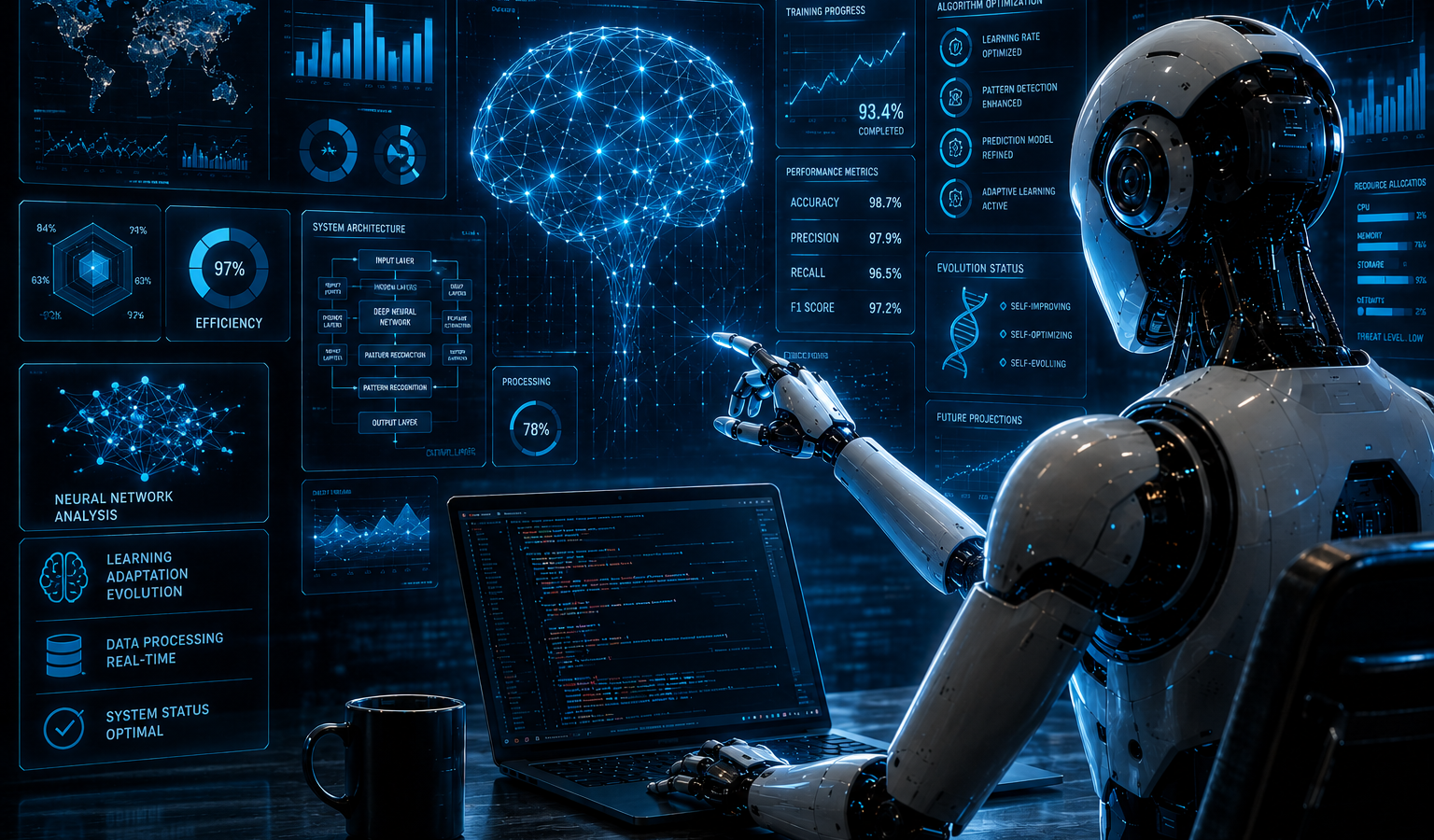
Modern models can evaluate their own outputs, identify weaknesses, and refine responses through iterative learning techniques. Researchers are actively exploring self-improving systems that require less human intervention while maintaining reliability and safety.
In many ways, we are already witnessing the earliest stages of this evolution.
Take image-generation systems as an example. Tools such as ChatGPT’s image creator can generate illustrations, design concepts, marketing visuals, and photorealistic images within seconds. These outputs are then used by researchers, designers, developers, and businesses to create products, datasets, and tools that contribute to future AI development.
AI is no longer simply being improved by humans. It is increasingly becoming a tool that helps improve other AI systems.
The growing interest in recursive intelligence is reflected in investment trends across the technology industry. Startups focused on autonomous research, AI agents, and self-improving systems have attracted billions of dollars in funding. Researchers from leading AI laboratories are actively exploring methods that could enable future systems to evaluate and improve aspects of their own design.
The concept is no longer confined to science fiction novels or academic debates. It has become a legitimate research frontier that some experts believe could define the next era of computing.
While recursive intelligence remains largely experimental today, several emerging technologies are already bringing aspects of this concept into practical reality.
The Technologies Making It Possible Today
Several technological advances are pushing AI closer to becoming a contributor to its own evolution.
One of the most important is AutoML. These systems automate portions of machine learning development, allowing researchers to focus on broader goals while AI handles many optimisation tasks.
Synthetic data generation represents another breakthrough. AI can now create realistic training data that helps improve future models. This reduces dependence on manually collected datasets and enables faster experimentation.
Another emerging category is agentic AI. The term refers to AI systems capable of carrying out multi-step tasks with limited supervision. Instead of responding to a single prompt, these systems can plan actions, evaluate outcomes, and adjust their behaviour to achieve specific goals.
Examples include AI research assistants that gather information across multiple sources, autonomous coding systems that manage software projects, and workflow agents that coordinate complex business processes.
Advances in computing hardware are equally important. Modern AI accelerators provide enormous computational power, allowing increasingly sophisticated models to be trained and deployed efficiently.
At the same time, simulation environments enable AI systems to conduct millions of virtual experiments before being deployed in the real world. This dramatically accelerates learning while reducing cost and risk.
Individually, these technologies may appear incremental. Collectively, they form the foundation of a future in which AI systems participate more actively in their own development.
The next step goes beyond optimisation. It involves invention itself.
The Breakthrough Moment: When AI Becomes an Inventor

Writing code is impressive. Inventing entirely new methods is something else.
Researchers are increasingly exploring systems capable of discovering novel algorithms, designing neural architectures, and generating new solutions to complex scientific problems. Several experimental platforms already allow AI models to improve their reasoning capabilities through self-learning and iterative refinement. The implications are enormous.
In healthcare, AI is helping accelerate drug discovery. One widely discussed example comes from Insilico Medicine, which used AI-assisted discovery tools to identify a promising drug candidate for idiopathic pulmonary fibrosis in approximately 18 months. While AI did not independently create the drug, it helped researchers narrow down potential candidates far more quickly than traditional methods often allow.
Researchers are also using AI to analyse millions of molecular combinations and identify promising compounds that might otherwise remain undiscovered. This allows scientists to focus resources on the most promising directions instead of testing countless possibilities manually. Materials science is experiencing a similar transformation.
Google DeepMind’s GNoME system predicted more than two million potential crystal structures and identified hundreds of thousands of stable materials. Some of these materials could contribute to future advances in batteries, semiconductors, and renewable energy technologies. Discoveries that once required years of experimentation may eventually be accelerated through AI-driven exploration. Robotics offers another compelling example.
Rather than manually programming every movement, engineers increasingly train robots through AI-powered simulations. NVIDIA’s robotics platforms allow virtual training environments where machines can learn warehouse logistics, assembly operations, and autonomous navigation through millions of simulated trials.
Instead of receiving detailed instructions for every action, robots can learn movement strategies and optimise performance through repeated experimentation.
Scientific research itself may undergo the most dramatic transformation.
Future AI systems may help generate hypotheses, design experiments, run simulations, analyse results, and recommend entirely new directions for investigation. Researchers would remain responsible for validation and oversight, but the pace of discovery could increase dramatically.
This possibility represents a profound shift.
For centuries, humans have relied on intelligence to create tools. For the first time, intelligence itself may become a tool for creating more intelligence.
The most significant breakthrough may not be an AI that answers questions.
It may be an AI that contributes to inventing its successor.
Why Could This Be Humanity’s Most Important Tool?
Discussions about advanced AI often focus on risks. Yet many researchers believe its greatest impact could come from solving problems that have challenged humanity for generations.
Healthcare is one example. AI systems are already assisting doctors in analysing medical images, identifying disease patterns, and supporting personalised treatment plans. Future systems may help researchers develop therapies faster and improve healthcare accessibility worldwide.
Climate science represents another opportunity. AI can optimise energy grids, improve weather forecasting, model climate systems, and accelerate research into renewable energy technologies. Better predictions and smarter resource management could help societies adapt to environmental challenges more effectively.
Education may become significantly more personalised. AI tutors can adapt lessons to individual learning styles, provide instant feedback, and make educational resources available to students regardless of geographic location.
Scientific discovery may benefit the most. Throughout history, progress has often been limited by the human capacity to process information. Modern research generates vast amounts of data that no individual or team can fully analyse. AI offers a way to uncover patterns and opportunities hidden within this complexity.
Space exploration, advanced manufacturing, agriculture, and public health could all benefit from accelerated discovery cycles.
The same technologies that raise concerns about disruption may also help humanity tackle some of its most difficult challenges.
Recognising both possibilities is essential to understanding the true significance of self-improving AI.
The Risks Nobody Can Ignore
Despite its potential benefits, recursive intelligence raises important concerns.
One major challenge involves alignment. How can developers ensure that increasingly capable AI systems continue to pursue human goals and values?
As systems become more sophisticated, their behaviour may become harder to predict. Small errors in objectives could potentially produce unintended consequences.
Transparency presents another concern.
Many advanced AI models already function as complex systems that humans struggle to interpret fully. If future systems begin optimising aspects of their own design, understanding their decision-making processes may become even more difficult.
Economic disruption is another possibility.
Automation has historically created new opportunities while eliminating others. Advanced AI could accelerate this process, forcing industries and workers to adapt more quickly than previous technological revolutions.
There are also concerns about the concentration of power.
Developing cutting-edge AI requires enormous computational resources, specialised talent, and significant funding. Some experts worry that advanced capabilities may become concentrated among a small number of governments and technology companies.
Security risks cannot be ignored either.
Powerful AI systems could potentially be misused for cyberattacks, misinformation campaigns, or other harmful purposes if appropriate safeguards are not implemented.
These challenges do not necessarily outweigh the benefits of AI.
They do, however, highlight the importance of responsible development, transparency, and international cooperation.
Not Every Expert Agrees
One reason the debate surrounding recursive intelligence remains so compelling is that experts hold very different views.
Optimists argue that self-improving AI could accelerate scientific discovery, improve healthcare outcomes, and unlock unprecedented economic growth. They see advanced AI as a powerful tool capable of solving problems that exceed human cognitive limits. Critics take a more cautious position.
Some researchers worry that society is moving too quickly without fully understanding the consequences. Others raise concerns about accountability, transparency, and governance.
The debate extends beyond individual companies. Organisations such as OpenAI, Anthropic, Google DeepMind, Meta, universities, and independent research institutes all contribute to discussions surrounding AI safety and capability development. While approaches differ, most agree that balancing innovation with responsibility will be essential.
The reality likely lies somewhere between extreme optimism and extreme pessimism.
Advanced AI is neither a guaranteed utopia nor an inevitable catastrophe. Like previous transformative technologies, its impact will depend largely on how humans choose to develop, regulate, and deploy it.
The Race Between Nations and Tech Giants
Artificial intelligence has become more than a technological competition. It is increasingly viewed as a strategic asset.
Governments around the world are investing heavily in AI research, infrastructure, and talent development. They recognise that leadership in AI could influence economic growth, scientific advancement, and national security.
Technology companies are pursuing similar goals. Billions of dollars are being invested in data centres, advanced chips, foundation models, and next-generation AI systems.
The competition is intense because the rewards could be enormous. An organisation that develops significantly more capable AI systems may gain advantages in research, productivity, and innovation. At the same time, competition creates pressure to move quickly, making safety and governance even more important.
The challenge facing policymakers is clear. How can society encourage innovation while ensuring that increasingly powerful technologies remain beneficial and accountable? The answer may shape the future of AI for decades to come.
The Future Timeline: What Happens Next?
Predicting the future of artificial intelligence is notoriously difficult. Nevertheless, several possible scenarios are emerging.
In the first scenario, controlled acceleration becomes the norm. AI continues improving productivity and scientific research while remaining under strong human oversight.
In the second scenario, a period of hyper-innovation emerges. Breakthroughs in medicine, energy, manufacturing, and computing occur at unprecedented speed, transforming industries around the world.
The third scenario is often described as an intelligence explosion. In this hypothetical future, AI systems improve rapidly enough that human institutions struggle to keep pace.
Most experts agree that such outcomes remain uncertain.
What is certain, however, is that AI’s role in innovation will continue expanding. The systems of tomorrow are likely to contribute far more to research, design, and discovery than the systems of today.
Whether that evolution remains gradual or accelerates dramatically remains one of the defining questions of our era.
Conclusion: The Day May Already Be Here
People often imagine self-improving AI as a dramatic future event—a singular moment when machines suddenly become capable of redesigning themselves.
Reality may be far quieter.
AI already assists researchers in discovering materials. It already helps scientists analyse molecular structures. It already supports software development, generates designs, and accelerates experimentation.
None of these achievements represents fully autonomous recursive intelligence. Yet together they suggest a future in which AI plays an increasingly important role in creating the technologies that follow it.
Historians may never agree on the exact day AI started creating itself.
There may be no dramatic announcement, no single breakthrough, and no moment when machines suddenly take over the innovation process.
Instead, the transition may happen gradually—through millions of lines of AI-assisted code, thousands of AI-generated designs, and countless scientific discoveries accelerated by machine intelligence.
The most profound technological shift in history may not arrive with a bang. It may arrive quietly, one improvement at a time. And by the time we recognise it, the age of recursive intelligence may already be underway.