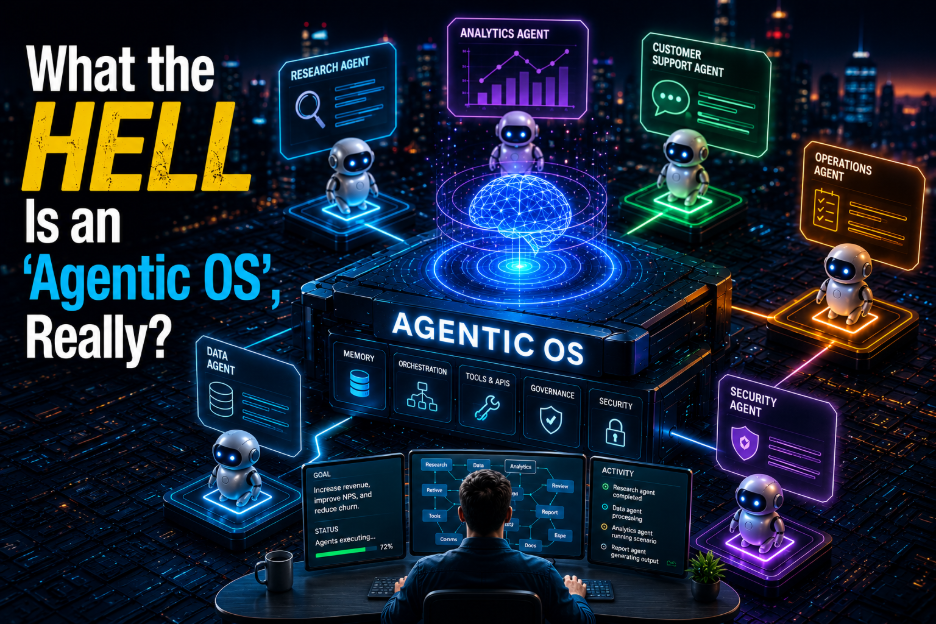
We pull apart the latest from the tech world to find out nitty-gritties of Agentic OS, inspect why it matters, and assess whether the hype has earned its keep.
There is a feeling of thrill that sets in when the tech industry rediscovers the word “operating system.” I suggest we begin with the basics by recalling what an operating system actually does in the first place. Your laptop OS does not ask for your permission to allocate RAM every time you open a new browser tab. It does not hold a meeting to decide which processor core should handle a background sync. It manages resources invisibly, arbitrates between competing processes, enforces rules so that applications can talk without destroying each other, and keeps the whole chaotic ecosystem from collapsing. The OS is the uncomplicated infrastructure that makes complexity feel effortless to the person working with it.
Now take that philosophy and apply it to AI agents. An agentic operating system is a software coordination layer that manages, orchestrates, and governs multiple AI agents working together to complete multi-step tasks without requiring a human to supervise every handoff. Where your laptop OS manages CPU time and memory allocation, an agentic OS manages context, tool access, decision logic, persistent memory, and the flow of instructions between agents that each specialize in different domains.
Agentic OS is an emerging software layer designed to coordinate, manage, and govern multiple AI agents working together across applications, data systems, and workflows. An operating system for AI agents instead of human-operated apps. In 2026, the closest we have reached to Agentic OS is a highly capable architectural structure with a set of components in layers assembled so that AI agents together can reason, act, remember, and collaborate without falling apart the moment things get complicated.
Technical Term Of The Day: “React Loop”
Every serious agentic system operates on a reason–act–observe cycle, known in the research literature as the ReAct pattern. The agent receives a goal, reasons for the next step, takes an action (calling a tool, querying a database, writing output), observes the result, and loops. This is what separates an agent from a chatbot. A chatbot answers once and stops. An agent iterates. An agentic OS manages these loops across multiple agents simultaneously — scheduling their iterations, preventing collisions, and recovering when a loop produces a result no downstream agent was expecting.
Who Is Actually Building This, and How
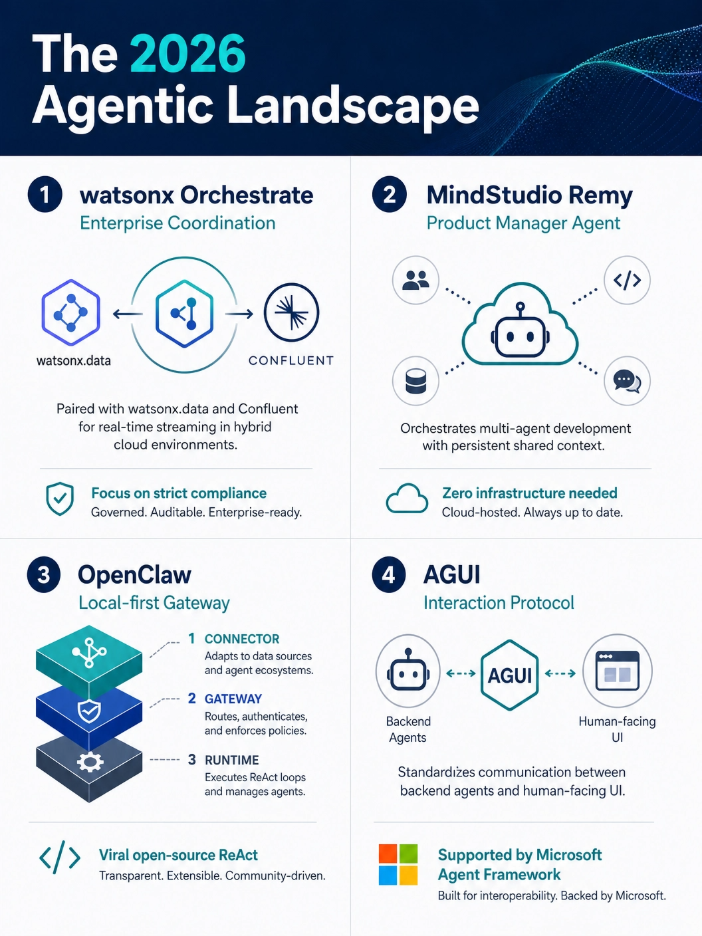
The landscape of agentic OS builders in 2026 is still a work in progress and splits into three distinct camps: enterprise platform players retrofitting existing software, open-source projects discovering the model the hard way, and purpose-built agentic infrastructure companies that are designed for coordination from the start. Understanding which camp a vendor belongs to tells you more about what you are buying than any feature comparison chart.
IBM’s entry is the most architecturally serious of the enterprise incumbents. At Think 2026 in Boston, IBM watsonx orchestrates alongside a clutch of adjacent capabilities that together constitute what IBM is calling “the AI Operating Model.” The platform positions watsonx.data — IBM’s lakehouse and data governance layer as the agent-ready foundation, while Orchestrate sits above it, handling multi-agent coordination. IBM also announced the acquisition of Confluent, the company behind enterprise Kafka and Flink streaming. watsonx agents are federated, a real-time view of business data with semantic meaning rather than stale snapshots from last Tuesday’s ETL job. IBM’s VP of Data at Think put it plainly: “The decisions that agents take are decisions that you have to be able to trust when agents act autonomously at machine speed. Governance can’t be after that fact.”
On the opposite end of the formality spectrum sits OpenClaw, the local-first agent platform created by Peter Steinberger, founder of PSPDFKit, in November 2025. This began as his personal project, which went viral in late January 2026, accumulating over 145,000 GitHub stars and 20,000 forks within days tied to the Moltbook launch. The adoption pattern of developers giving the system autonomous control over their email, files, terminal, and messaging apps was genuinely revelatory about how far appetite had outrun safety thinking. Three high-severity security advisories dropped on January 31st. CVE-2026-25253, a one-click remote code execution vulnerability scoring CVSS 8.8, was announced on February 1st. OpenClaw renamed itself twice a week — Clawdbot to Moltbot after a trademark complaint from Anthropic, then to now, as we know OpenClaw, all while becoming one of the most discussed agentic architectures in practitioner circles. Its three-layer design (Connector for multi-channel communication, Gateway Controller for session-aware memory, Agent Runtime executing ReAct loops) is a clean, open-source implementation of the patterns that power serious agentic deployment. Its security trajectory is used as a case study in what happens when adoption precedes governance, which is another day’s discussion.
MindStudio’s Remy is the master agent that runs the project itself and acts like a product manager of the multi-agent system. Remy manages the other agents, coordinates the layers, and ships the application. MindStudio’s underlying insight, spelled out across their April 2026 engineering posts, is that AI agents do not forget because they are dumb. They forget because there is no persistent place to store what they have learned. An agentic OS solves that by treating the specification and project context as a persistent, shared truth that both humans and agents can read and reason across sessions. Remy is the first implementation of that idea to achieve commercial traction outside the enterprise tier.
The Dark Data Creating A Crisis
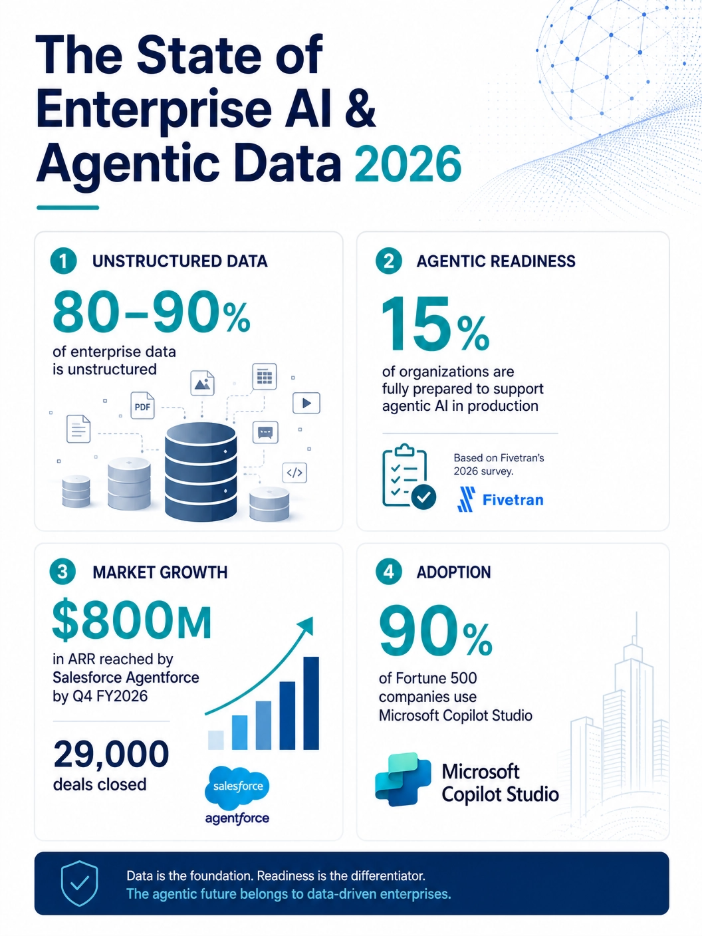
Contracts, customer emails, scanned forms, meeting recordings, PDFs from legal teams, and voice transcriptions from sales calls are the data that sit, and practitioners are calling those “dark data.” Stored, retained, backed up, and completely invisible to any agent that is attempting to reason for the business it supposedly serves. The industry numbers show a low percentage of enterprise operations are currently in a form suitable for AI consumption. The AI reliability problem is a data problem before it is ever a model problem.
The consequences are not hypothetical. When agents act on stale, incomplete data or data without known attributes, they do not fail with a polite error message. They make decisions at machine speed, across multiple systems simultaneously, that reflect the gaps in that data with perfection. An underwriting agent pulling yesterday’s rent rolls to model a real estate deal misses rent bumps that closed this morning. The mistake compounds when you are using a multi-agent system, and the problem propagates faster and further than any single human error; also, because of the restraining proclivity to recheck agents’ answers. Salesforce’s Agentforce Operations, launched generally in April 2026, attempts to address this by giving agents explicit task decomposition for back-office processes such as process coordination, data verification, compliance checks, and approval routing, but the effectiveness of those decompositions is still bound by the data feeding them.
Real-World Value Across Core Industries
The vision of an Agentic OS is compelling, but its real significance becomes clear when deployed inside the economy’s operational business systems. Autonomous AI agents are replacing static processes.
Today, agentic agents can reason, plan, and execute multi-step workflows, creating space for Agentic OS built to sustain collaborations, adaptivity, dynamic knowledge, and precision.
- Hyper-Automated Customer Experience and Support
Traditional customer support relies on rigid decision trees or basic chatbots that easily stumble when faced with nuanced customer inquiries. An Agentic OS will transform customer service by assigning autonomous agents capable of diagnosing complex, compiling multi-layered customer issues with the uniform system applied to all CS departments of the business.
- Autonomous Financial Analysis, Risk, and Compliance
Financial services firms are also rapidly adopting agentic workflows to manage increasingly complex data environments. AI agents can monitor market feeds, regulatory updates, corporate filings, and macroeconomic indicators in real time. These systems with autonomous dashboards today can model portfolio risks, detect anomalies, generate compliance summaries, and simulate future market scenarios far faster than traditional manual analysis.
- Healthcare Operations and Clinical Coordination
Healthcare organizations are exploring agentic coordination systems to reduce administrative burden. AI agents have immense possibilities, including appointment scheduling, insurance verification, medical documentation, symptoms cross verifications, research collaborations, patient records, and care coordination across departments. These systems are not replacing clinicians but helping reduce operational inefficiencies that contribute to burnout and delayed care.
Our Current Day Verdict
The concept of Agentic OS engineering is sound and maturing. The production results in organizations that built the data foundation first are genuinely impressive. Salesforce Agentforce autonomously resolved 70 percent of customer chat sessions for 1-800Accountant during peak tax season. Microsoft’s banking assistant resolved 75 percent of customer requests at Commerzbank across 30,000-plus monthly conversations. ServiceNow achieved 80 percent ticket deflection at CANCOM. IBM’s watsonx deployment at one large US financial firm delivered $5.7 million in annual cost savings while improving audit-readiness. These are not cherry-picked demos.
Every one of those organizations built the data layer before, or in close parallel with, the agent layer. The ones that deployed agents first and planned to “sort out the data later” are the ones accumulating toward failure or re-route.
The “Agentic OS” label also continues to suffer from agent washing, with vendors relabeling RPA scripts, linear chatbots, and deterministic workflow tools as agents because the word is selling right now. Genuine agentic capability requires autonomous multi-step reasoning, correcting errors, and real-time context. When evaluating a platform, run a task that breaks halfway through and requires an unexpected recovery path. This test will tell you system defaults and requirements you did not think of before.
The operating system analogy holds not because it is elegant but because it is accurate. Every computing era needs a coordination layer that makes complexity invisible.